 Listen


 Facebook
 Reddit
 Copy Link


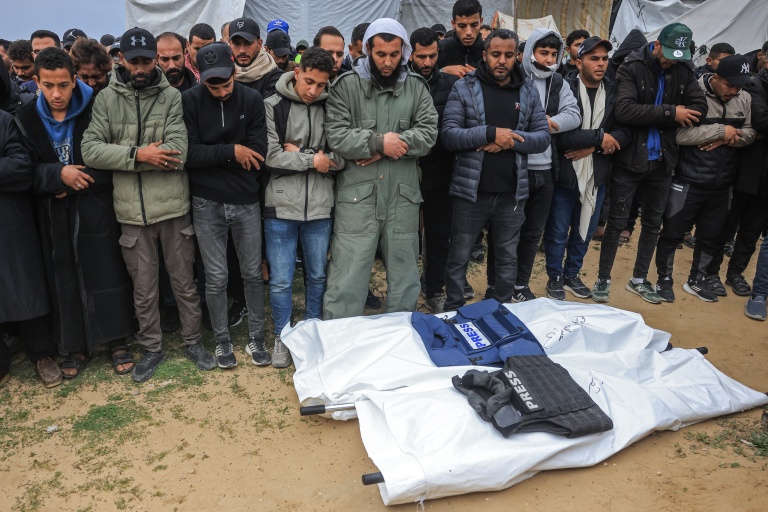
LOS ANGELES (UNITED STATES) - How do journalists report on a war when they become victims of the violence, and when their proximity to the conflict is used to paint them as unreliable witnesses?
That's the issue explored in Inside Gaza, a new documentary that follows journalists from global news agency Agence France-Presse (AFP) who were trapped in the territory as Israel exacted a fearsome revenge for Hamas's Oct 7 attack.
Director Hélène Lam Trong brings these news industry veterans in front of the camera, showing how they balance the difficult task of reporting on the massive military response with their own survival, as it destroys their city, killing family, friends and colleagues.
"Most international correspondents... cover a war or a news event and then return home to safety," freelance journalist and documentary filmmaker Lam Trong told AFP in Los Angeles, where the film was shown as part of The American French Film Festival.
"Palestinian journalists could not do that. They were trapped alongside the civilian population of Gaza, with no way out; as the days passed, they themselves became victims of the war."
Questioned
The Hamas-led attack on Israel on Oct 7, 2023, killed more than 1,200 people, the vast majority of them civilians. Armed men also took more than 200 people hostage.
Israel almost immediately sealed the borders of the Gaza strip and barred international journalists from entering.
It then launched an enormous military response, pulverising swathes of Gaza in attacks that have left 73,000 people dead, according to the Hamas-run Gaza Health Ministry, whose figures are considered reliable by the United Nations (UN).
Unable to send a team of reinforcements, AFP was solely dependent on the work of its local staff — experienced reporters, photographers and videojournalists, many of whom have worked internationally — to document Gaza's subsequent descent into violence and despair.
Without journalists like these, whose work was transmitted to AFP's thousands of media clients, the outside world would have had no idea what was happening inside Gaza, Lam Trong said.
In the film, which was compiled from material produced by the team on the ground, as well as from interviews conducted after they finally left, the journalists speak of the frustration of seeing their work either called into question or simply never broadcast or published.
In one sequence, the team describes their frustration at the way in which Israeli propagandists claimed genuine photos of a dead child were staged using a doll.
"At AFP, our photos, news reports and videos are used by world media outlets. But in this war, some of our images were never used," says Gaza bureau chief Adel Zaanoun.
"It worried us, even terrified us, because from the very first days, the thousand of Palestinians killed didn't count for the media."
The costs of reporting
At a time of declining engagement for traditional journalism as audiences migrate to unmoderated social media platforms and politicians seek to demonise any outlet publishing stories they do not like, Lam Trong says it is vital the public understands how newsgathering works — including the costs and the risks to those who do it.
That includes becoming targets themselves. According to the Committee to Protect Journalists and Reporters Without Borders, approximately 200 journalists have died in Gaza since the war began.
AFP's office in Gaza, which was broadcasting a live feed to clients, was hit, likely by Israeli tank fire, according to an investigation by the agency and other international media outlets.
"In Gaza, in particular, journalism and journalists have become central issues, as they have been killed, attacked and persecuted," Lam Trong said.
"We do not deserve to be accused of propaganda when we conduct on-the-ground reporting," she said.
Lam Trong, a recipient of the Albert Londres Prize — often described as the French equivalent of the Pulitzer — hopes the film, which has won numerous international awards and is eligible for Oscar contention, will spread the message of the importance of journalism.
The awards season campaign is "an opportunity to bring a very important message to Hollywood... that freedom of the press is under threat and that we must defend journalists — not just journalism, but the journalists themselves."
AFP's staff left Gaza in 2024. The agency continues its impartial coverage of the region using trusted freelance contributors.


