 Listen


 Facebook
 Reddit
 Copy Link


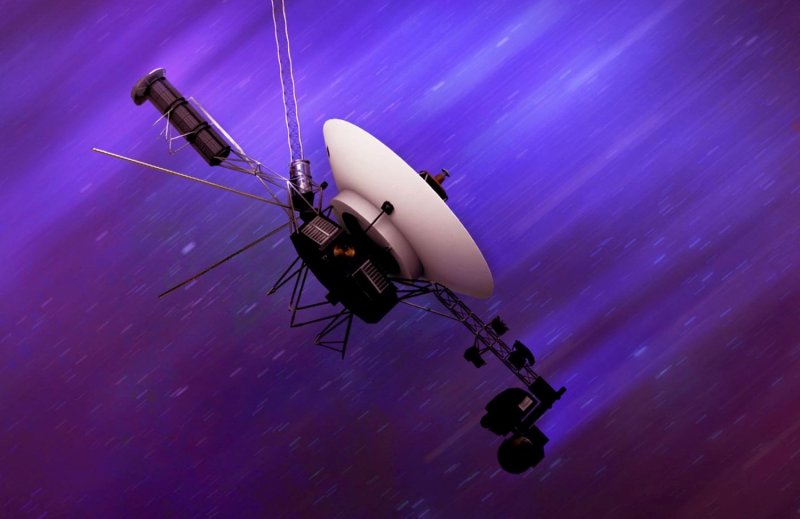
WASHINGTON - Voyager 1 has already travelled farther than any other spacecraft from Earth since its launch in 1977. The probe, which exited our solar system years ago and is journeying through interstellar space, is now on the cusp of a remarkable milestone — traversing a light-day, the distance light travels in 24 hours.
A light-day is about 16 billion miles, or 26 billion kilometres. A car driving nonstop at 60 mph would need 30,421 years to cover that distance.
The US National Aeronautics and Space Agency (NASA) says that Voyager 1, flying at almost 38,000 miles per hour (61,000 kph) through the virtual vacuum of space, will reach that distance from Earth on Wednesday at 5.16am Eastern Time (1016 GMT). The robotic spacecraft has the distinction of being the most distant human-made object.
“I view it as an engineering milestone, marking the amazing longevity of Voyager 1 — and also an engineering achievement to be able to communicate with Voyager 1 at its distance,” said astrophysicist Alan Cummings, a senior research scientist in the Space Radiation Laboratory at Caltech who has been a Voyager programme scientist since 1973.
A light-year may be a more familiar concept for many people, a metric used for vast cosmic distances. It is the distance a particle of light, called a photon, travels in a year — about 5.9 trillion miles (9.5 trillion km). The closest stars beyond our solar system are the three that make up the Alpha Centauri system, about 4.24 light-years away.
Voyager 1 and its twin Voyager 2 were launched 49 years ago, exploring planets in the outer solar system before continuing onward. Voyager 1 was carried into space on Sept 5, 1977, atop a Titan IIIE-Centaur rocket from Cape Canaveral in Florida 16 days after the launch of Voyager 2, but overtook its twin within months.
“Voyager 1 returned a wealth of new information about Jupiter and Saturn, and their moons,” Cummings said.
It discovered a thin ring around Jupiter and two previously undetected Jovian moons, Thebe and Metis. It then spotted five new moons around Saturn as well as a ring called the G-ring.
“Voyager 2 took a different path through the solar system after they launched in 1977, in order to visit Uranus and Neptune. Voyager 2 is on pace to be one light-day away from Earth in nine more years, in November 2035,” Cummings said.
Leaving the heliosphere
Voyager 1 crossed the outer edge of the heliosphere, a protective bubble of particles and magnetic fields produced by the sun, and entered interstellar space in 2012, continuing to collect data.
“It was the first spacecraft to report the energy spectra of galactic cosmic rays (fast-moving energetic particles) at low energies,” said Cummings, an expert in cosmic rays.
“Those energetic particles are not observable inside the heliosphere because of the push-back by the solar wind. This was the holy grail of low-energy cosmic ray physics.”
Voyager 2 entered interstellar space in 2018.
Cummings became part of the Voyager team by accident after a balloon-borne experiment concerning cosmic rays that was the basis of his Caltech doctoral thesis failed to land in northern Canada as planned.
“It went around the world a time and a half, and was eventually captured by the Soviet Union. It landed apparently without the benefit of the parachute and was essentially destroyed,” he said.
“It was decided that the experiment was finished, and I was offered a job on the Voyager Cosmic Ray Subsystem (instrument) fairly soon after it began development in 1973.
“The loss of the balloon was lucky for me as the Voyager mission has been the backbone of my career. I’ve been working on it and analysing data from it for 53 years,” Cummings said.
He joined the Voyager team at age 29 and is now 82.
Golden Record
Both Voyagers carry a Golden Record, a device intended to communicate Earth’s story to any intelligent extraterrestrial beings who may encounter the spacecraft. The phonograph record, a 12-inch gold-plated copper disk, contains various images and sounds to convey our planet’s culture.
It features music like rocker Chuck Berry’s Johnny B Goode, Beethoven’s Fifth Symphony and Aboriginal songs from Australia, as well as spoken greetings in 55 languages and instructions for locating Earth.
Some experts have subsequently questioned the wisdom of providing directions to our planet, in case covetous hostile beings come across the Golden Record.
“I’ve heard that concern a little over the years but I never worried about it. It’s pretty unlikely the aliens will find it,” Cummings said.
