


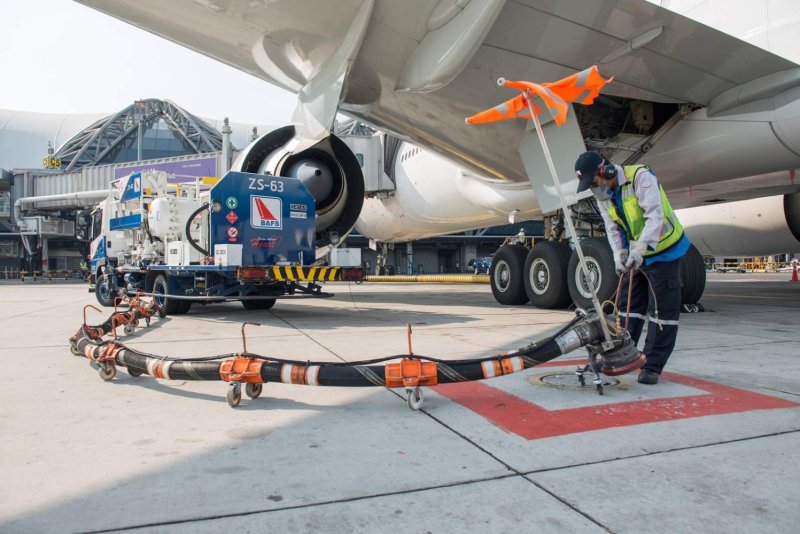
Bangkok Aviation Fuel Services Plc (BAFS), Thailand's sole jet refuelling provider, has called on the government to exempt jet fuel from the excise tax of 4.72 baht per litre, warning the levy undermines the country's aviation competitiveness.
Business leaders in the aviation industry support the proposal as fuel prices have surged because of the energy crisis, following the Israel-US war on Iran.
ML Nathasit Diskul, president of BAFS, also voiced concern over the difference in tax rates between Thailand and neighbouring countries.
Short-haul and international airlines within Southeast Asia are exploiting loopholes to avoid refuelling at Thai airports, where the tax inflates operating costs and airfares, he noted.
Instead, carriers refuel elsewhere where charges are lower or nonexistent.
For example, airlines flying routes such as Bangkok-Phuket-Kuala Lumpur or Chiang Mai-Bangkok-Ho Chi Minh City often bypass domestic refuelling.
Refuelling in Kuala Lumpur or Singapore is tax-free, while in Ho Chi Minh City the tax is only 1.2 baht per litre.
Jet fuel excise tax remains one of the largest expenses for airlines.
The levy was temporarily waived during the pandemic, then reinstated in 2023.
ML Nathasit warned that without reform, Thailand risks losing ground to regional competitors.
"If nothing is done, Thailand's aviation competitiveness will not only fall behind Singapore, but also Vietnam as it builds several new international airports," he said.
"This is occurring as Thailand claims to seek aviation hub status."
Airlines are demanding measures to deal with soaring fuel prices, which have prompted some carriers to increase airfares.
In early March, the Airlines Association of Thailand asked the government to cut the excise tax on jet fuel.
Nuntaporn Komonsittivate, head of commercial at Thai Lion Air, said a tax reduction measure may take longer to implement, so more immediate efforts should be prioritised to help lower costs, such as postponing planned increases in operational fees at major airports.
Thai Lion Air said the jet fuel price has increased by 70% since the beginning of March.
The impact of soaring fuel prices is expected to last for at least 1-2 months, prompting the airline to monitor travel demand more closely, particularly during the Songkran holiday, she said.


