


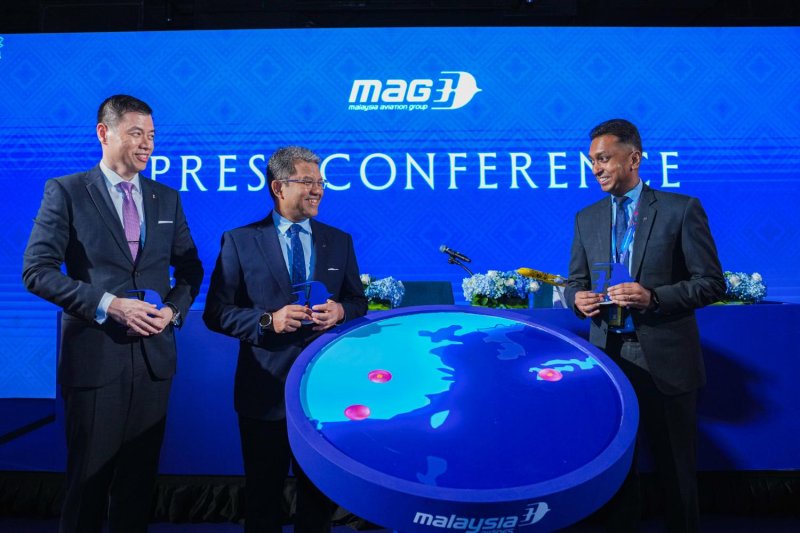
Malaysia Airlines is banking on Kuala Lumpur as an aviation hub, competing with Bangkok and Singapore in Southeast Asia by connecting the region to medium- and long-haul destinations as it adds three new routes in China and Japan to capture strong demand.
"We never miss an opportunity for recovery, and we want to position ourselves strongly in building Kuala Lumpur as a hub," said Bryan Foong, chief executive of airline business at Malaysia Aviation Group (MAG), the operator of Malaysia Airlines.
At Malaysia's largest international travel fair last week, the airline announced it is resuming operations to Fukuoka after nearly two decades, in response to high travel demand for Japan.
Malaysia Airlines is also adding two new routes to Shenzhen and Changsha in the third quarter this year, bringing the total to seven destinations on the mainland and three in Japan.
The new routes support direct-point traffic to and from Kuala Lumpur airport, aligning with the nation's Visit Malaysia 2026 vision.
The airline expects transit passengers from other regional destinations and Australia to travel across its network via this hub.
Beyond East Asia, Malaysia Airlines plans to increase flight frequencies on notable routes such as Brisbane, Manila and Colombo, as well as operate ad-hoc flights this month between Kuala Lumpur and London to accommodate passengers affected by the Middle East conflict.
"With the network we've put in place, we are focused on connecting traffic from long-haul and medium-haul routes into Southeast Asia, as well as domestic destinations," said Mr Foong.
Malaysia Airlines offers a "Bonus Side Trip" programme, allowing passengers who book international flights with a stopover in Kuala Lumpur to visit eight domestic destinations for free. Travellers are required to pay the taxes included in the airfares.
Nasaruddin A. Bakar, president and group chief executive of MAG, said the airline ordered 95 aircraft, including 40 Airbus A330neos and 55 Boeing 737-8 and 737-10 jets. Deliveries are expected over 6-7 years.
The airline's Boeing 737-10 jets feature a new lie-flat business class. In the first phase of its fleet modernisation, new aircraft will comprise 25 Boeing 737-8s and 20 Airbus A330neos, stationed by 2028.
By 2035, the airline expects to operate 116 aircraft.
Mr Bakar said the three latest routes are served by Boeing 737-8s, although the airline could switch to larger aircraft such as the A330neo in the future.
Regarding the Middle East conflict, he said the group is maintaining its growth strategy for flagship Malaysia Airlines as well as its low-cost airline Firefly, and continues investing in its products.
Travel demand remains high, with a load factor of more than 85% across most destinations, said Mr Bakar.
The airline is reviewing and adjusting airfares accordingly to remain competitive, given the oil crisis, he said.
By 2030, Malaysia Airlines aims to rank among Skytrax's top 10 global airlines.


