Listen


 Facebook
 Reddit
 Copy Link


Spot diesel prices could surge to US$200 per barrel if supply disruptions in the Middle East worsen, placing Thailand's heavily indebted Oil Fuel Fund under greater strain and increasing the likelihood of fuel tax cuts to shield consumers from rising energy costs, note analysts.
The global energy market was thrown into fresh turmoil by a new wave of geopolitical conflicts in the Middle East, according to Wattanapong Kurovat, director-general of the Energy Policy and Planning Office (Eppo).
Attacks by Yemen's Iran-backed Houthi rebels on Saudi energy infrastructure and commercial vessels in the Persian Gulf have disrupted supply chains and raised transport costs.
Many tankers have been forced to take longer routes around Africa instead of passing through the Red Sea, reducing oil flows into Singapore and tightening regional fuel supplies.
The situation was exacerbated by a larger-than-expected drawdown of 3.2 million barrels in US crude inventories, signalling tighter global supply conditions and helping push oil prices higher.
On Oct 20, Singapore diesel spot prices jumped to $178 per barrel, while gasoline was trading at about $136 per barrel, said Mr Wattanapong.
The surge in fuel prices has increased the subsidy burden on the Oil Fuel Fund, which is spending about 229 million baht a day to support domestic energy prices, he said.
The fund's net deficit tallied 102 billion baht as of Oct 11, comprising 60.8 billion baht in subsidies for diesel and gasoline and 40.9 billion for liquefied petroleum gas, according to Eppo.
To preserve liquidity and maintain long-term price stability, the Oil Fuel Fund Office recently approved adjustments to retail fuel prices and subsidy mechanisms.
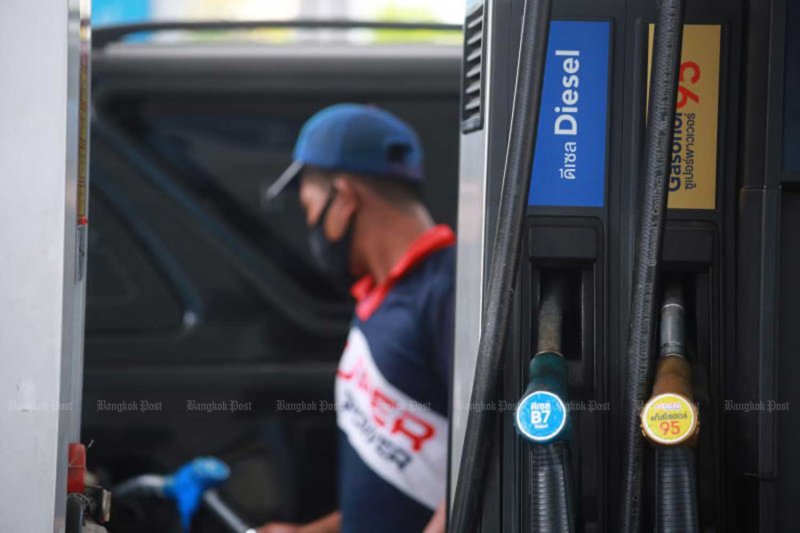
As a result, diesel and gasohol prices were raised by 0.60 baht per litre. Diesel B7 was priced at 43.54 baht per litre on Wednesday, while gasohol 95 rose to 42.04 baht.
An energy official who requested anonymity said the government's last resort to protect consumers and limit the cost-of-living impact would be to reduce fuel excise taxes if oil prices continue rising towards $200 per barrel.
According to Eppo, excise taxes on gasoline and gasohol range from 1.12 to 7.50 baht per litre, while diesel taxes range from 5.95 to 6.93 baht per litre, depending on the biofuel blend.
The official said it remains unclear whether elevated prices will persist into early next year or prove short-lived, as markets are being influenced by unpredictable factors including geopolitical tensions and increased winter energy demand in the Northern Hemisphere.
Praipol Koomsap, an economist at Thammasat University and former aide to ex-energy minister Narongchai Akrasanee, said diesel prices could reach $200 per barrel, similar to levels seen during the 2022 Russia-Ukraine conflict.
With conflicts continuing simultaneously in both Europe and the Middle East, he said it was difficult to predict when energy markets would stabilise.
Government officials and oil executives cautioned that additional borrowing to subsidise fuel prices could further strain public finances at a time when Thailand already faces a heavy debt burden.