
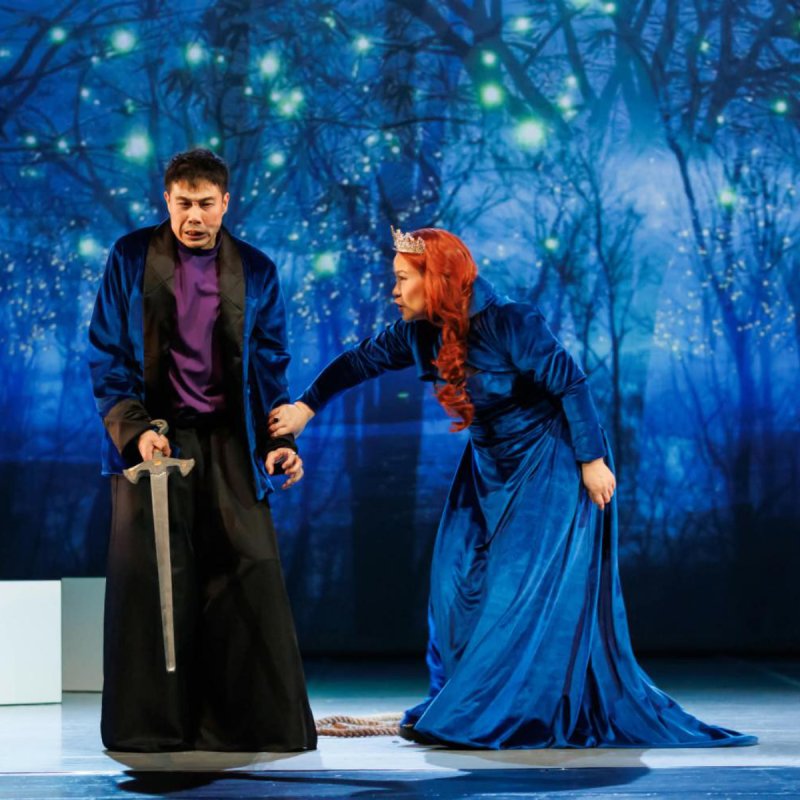
Singapore Lirica Arts is a relatively new organisation and last week's production of Verdi's Macbeth was its very ambitious first full-scale opera production.
A bold choice indeed, as opera companies in Southeast Asia often concentrate on "Top 10" productions, so there is a plethora of productions of Madama Butterfly in the region -- but Macbeth was also done in Singapore 25 years ago.
Verdi wrote a lot of quite minor work at the beginning of his career, often imitative of predecessors like Donizetti, but his endless grinding away paid off as he honed his craft. Macbeth stands at the cusp of this transition.
The first of his three Shakespeare operas, it contains much of the brilliance of the middle period masterpieces like Rigoletto, but it does relapse into tum-ti-tum triviality from time to time as well.
Verdi wrote the opera in 1847 and did an almost complete rewrite -- in French -- in 1865, as a much more mature and confident composer, giving Lady Macbeth a lot more to do and deepening the characters' complexities. The version often performed today is 1865, but translated back into Italian, and often with the extensive ballet sequence for the witches excised.
Neither version could be considered perfect, but both are an engaging window into Verdi's thoughts at two very different times of his life. Lirica Arts, which is run by artistic director Martin Ng, also an accomplished operatic baritone most recently seen in Bangkok in Mae Naak and Madana, chose the 1865 version, sans ballet, as its starting point.
Verdi's Macbeth. Lirica Arts in Singapore
In a way this was a shame. Ng himself was by far the strongest cast member, filling every utterance with nuance and depth, and the 1865 version finishes Macbeth off quickly (off-stage in fact, though in this version he dies onstage and is dragged away in a sack, as if he were the Duke in Rigoletto) and doesn't give him a big death aria with which to have the final word.
Throughout the opera, Ng showed an evolving characterisation as the burden of guilt piled up. Given Ng's dramatic abilities, it was a pity not to have borrowed his death scene from the 1847 version of the opera.
The 1865 version instead highlights Lady Macbeth, in this performance sung by Chinese soprano Zhang Jie, who grappled heroically with the demanding role, but essentially only displayed two musical personas, a winsome one and a "screaming mad queen" one.
In the iconic aria La Luce Langue, more colouristic variety would have been welcome, and in the sleepwalking scene, one never got the impression that she was lost in another universe. It must be said that there's a very high bar, set by Maria Callas, for this role. Still, Ms Zhang provided some excellent high drama and was very popular with the audience.
Particularly effective was Martin Ohu in the small role of Banquo, and Jonathan MacPherson as Malcolm. Indeed the casting of the comprimario roles was exemplary throughout. The chorus had ragged moments, but as it was the first performance, it could be attributed to opening night jitters.
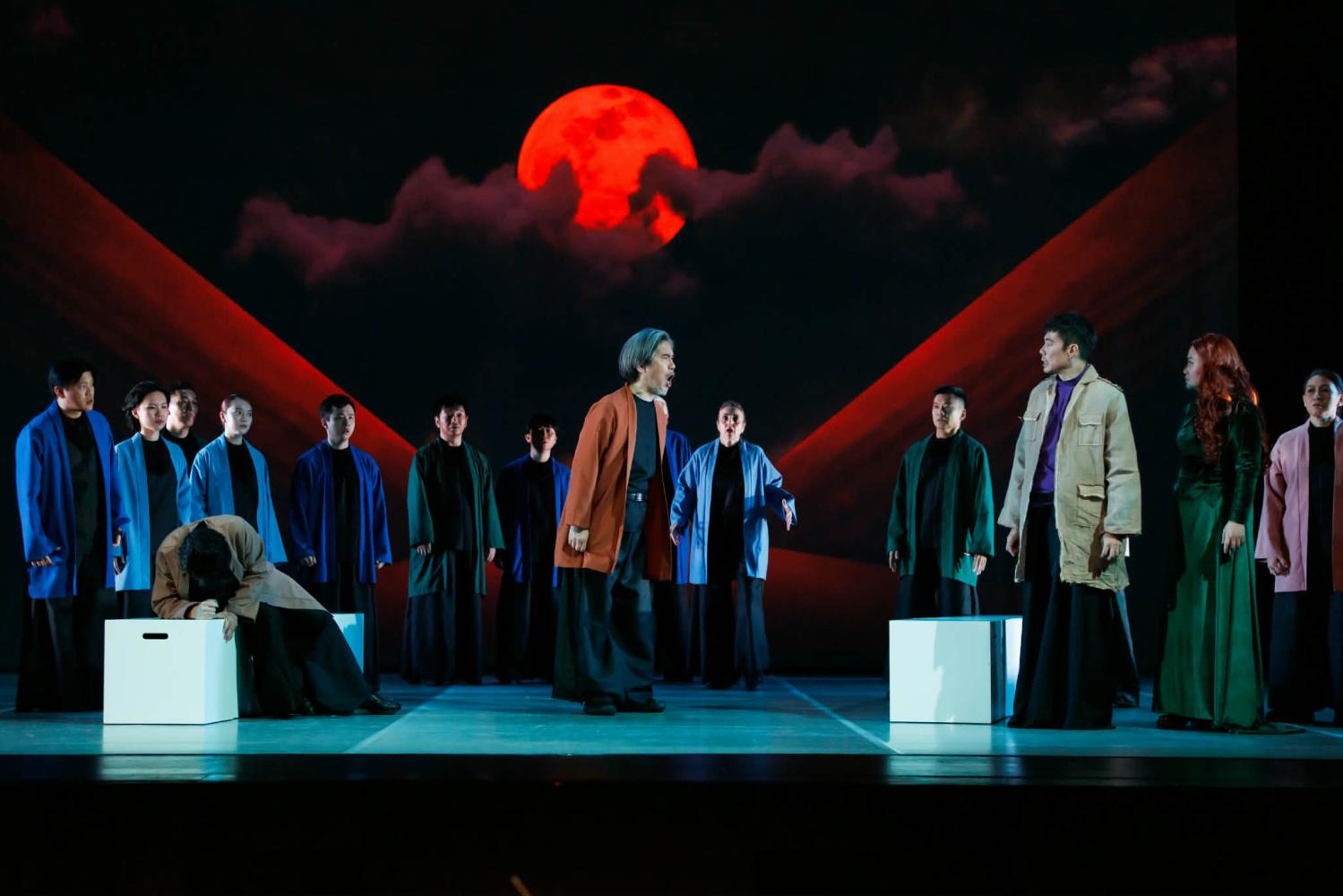
One thing that must be said is that every single moment of this production looked exquisite. The placement of the characters and of the set itself (which consisted entirely of movable white boxes), and the tasteful use of scenery projection and lighting made for a handsome production.
Director Tan Xinxin chose an extremely static, stylised presentation. It is certainly a valid interpretation -- one could easily imagine this concept in an opera house in Germany.
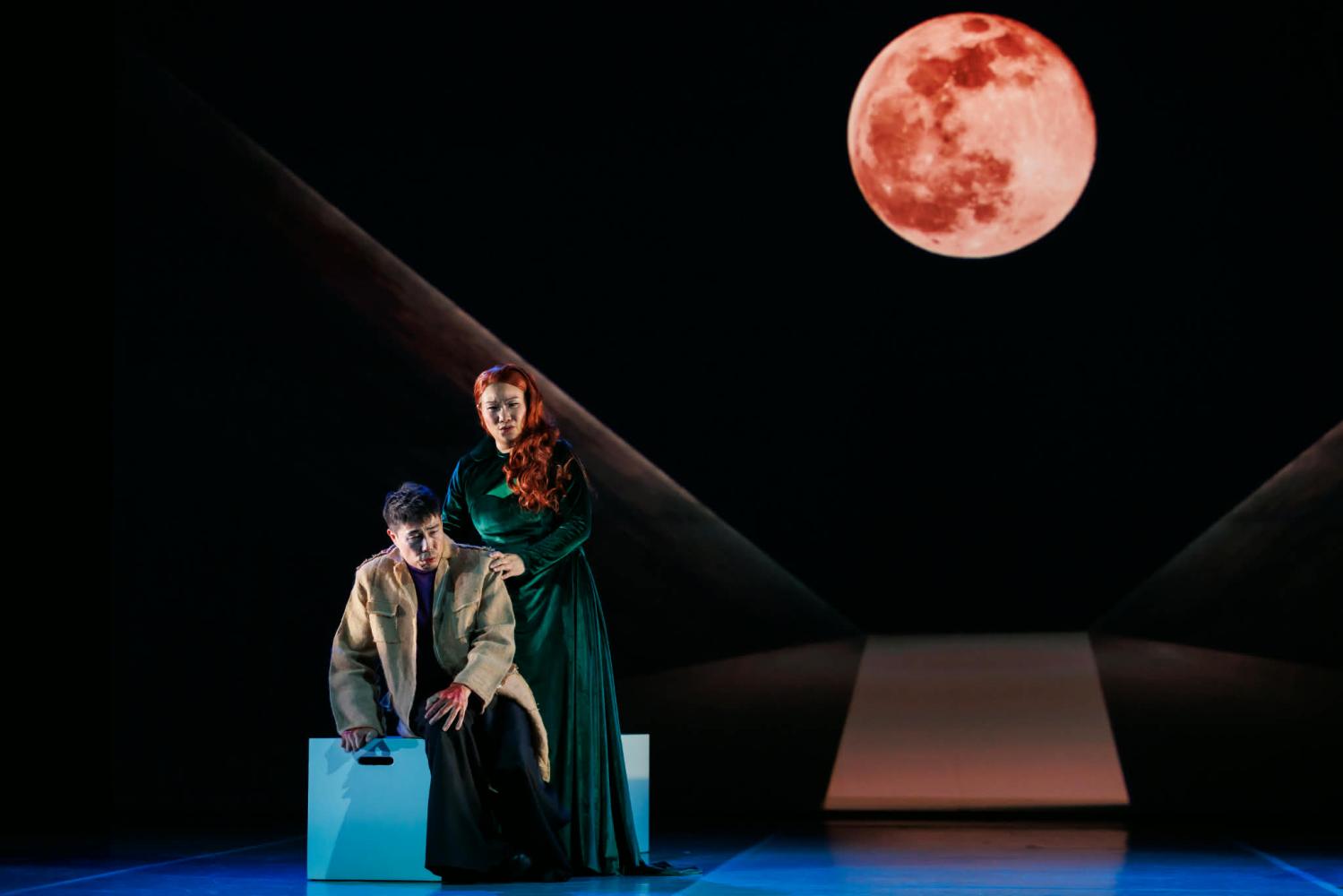
I'm sure she intended that the stillness of the tableaux would act like iron bars, caging in the raging drama, heightening the tension and symbolising the dark fate of the characters and how Macbeth is imprisoned not just by his crimes, but by his guilt, and by his wife's incessant urging.
But for this to work, it really requires that the performance of the music must wring out every ounce of bloodthirstiness that's written into the score.
It would be accurate to describe Lin Juan's conducting of this work as "safe". Many times, the singers, especially Ng, seemed to be fighting against the four-square reading to create a more idiomatically Italian sense of rubato and movement. It did not help that they elected to use a reduced orchestration with single woodwind and most of the brass missing. With fire-and-brimstone music direction, this could still work, but especially with the way this show is directed, intentions seemed crossed at times.
In all, this was a thoughtful and thought-provoking reading of an opera rarely seen in Southeast Asia. It is an important debut for what promises to be a significant regional player.
S.P. Somtow is the pen name of opera composer and director Somtow Sucharitkul, a Thai National Artist.