 Listen


 Facebook
 Reddit
 Copy Link


Opera in Thai is a challenging prospect. In addition to handling the aspects of choosing a librettist, creating an effective operatic structure and writing for that most finicky of instruments, the human voice, a composer has to deal with the Thai language.
A language in which inherent tones place a built-in melodic line into each sentence.
To compose an opera in Thai, you have to start off by making a decision on the tones -- ignore them, or allow them to dictate your composing style? I had this conversation in the 1980s with K. Paiboon, co-founder of Grammy.
He said that in the Thai pop industry, a conscious decision was made to start ignoring the tones, as was earlier done in Chinese pop music. Only then, he explained to me, could Thai pop music begin to compete globally.
He was right. Thai pop music dropped the tones and moved onto the world stage.
Traditional Thai music, and most other music that aims to sound "Thai" in one way or another, still give the tones dominance.
This means, if you speak Thai, the words are easier to understand (especially if they are poetic or otherwise not regular contemporary speech). But what about opera?
I was very interested to see how Morakot Cherdchoo-ngarm, a prominent classical musician who has made a name for himself as a vocal accompanist and therefore can be expected to know the vocal repertoire really well, would handle this problem.
Fatima is the first opera (in the Western sense) that I've seen premiered in Thailand. There are a few others. Thanapoom Sirichang's chamber The Lunch Box, for example, premiered in Tasmania.
The first opera in Thai in the broadest sense of the word was Bruce Gaston's Chuchok from the 1970s, which was performed in an entirely Thai-traditional milieu accompanied by a piphat ensemble. His recent opera A Boy And A Tiger was in Thai as well, but Gaston confessed to me that he had actually set it to music in English and translated it later.
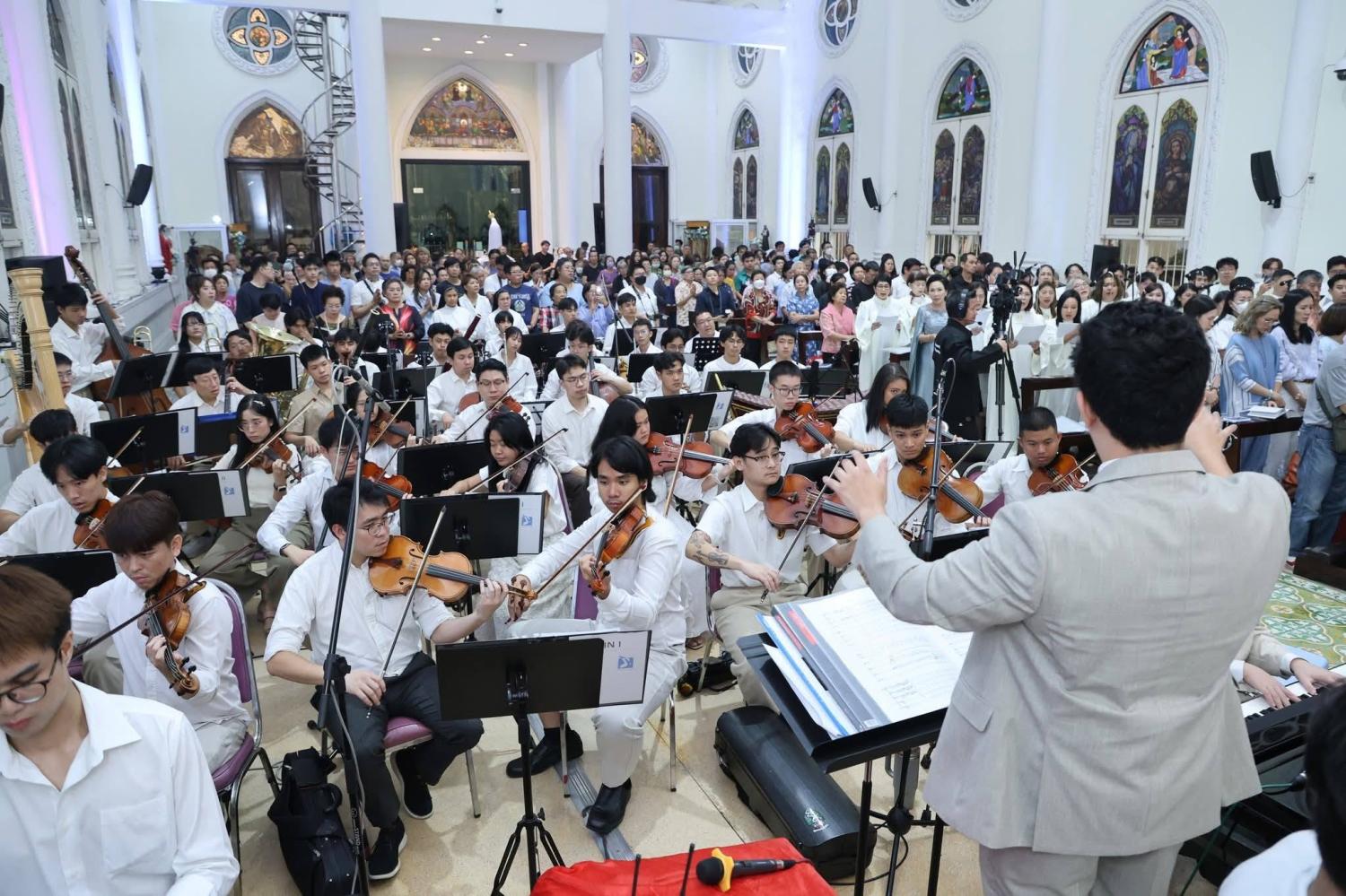
Morakot takes the radical approach and ignores the tones for the most part, making this opera easier to compose in a "Western" idiom. Fatima is a lovely little piece, full of expansive melodies with a full-scale orchestral accompaniment.
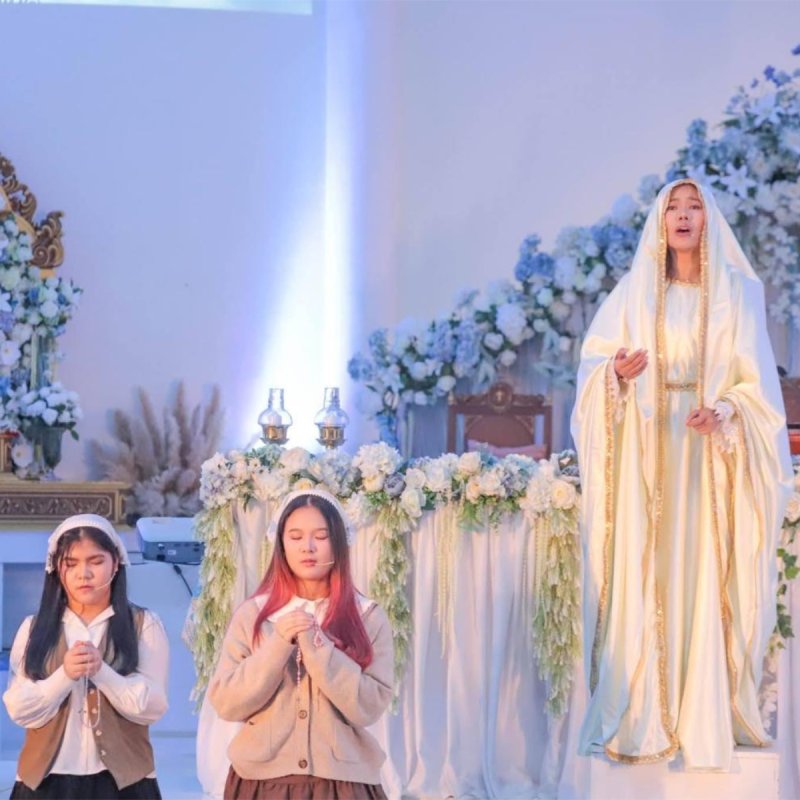
The plot is basically the story of the appearance of the Virgin Mary to three shepherd children in Portugal about 100 years ago.
There's plenty of drama as the children are disbelieved and threatened by a town official with being boiled in oil if they don't retract their story, and some moving arias sung by the Virgin herself, played by Chanya Maneewan, a very engaging young singer who was recently seen in Opera Siam's production of Orfeo as Euridice. Fatima was performed as a prelude to the annual Oct 13 ceremonies in celebration of the Fatima miracle, at the Fatima Church in Din Daeng, so the audience for the 30-minute opera was also there for the mass.
The performance wasn't much advertised in the music community and I only found out about it by chance, but this production is clearly an important event in the history of opera in Thailand. I dearly wish more of our music colleagues had known about it.
In addition to Chanya's superb portray of the Virgin Mary, I would also have to mention Worawee Saikhum who played the role of the disbelieving official who bullies and imprisons the children.
Worawee's role carried the brunt of the work when it came to Morakot's setting of the Thai language dialogue, with difficult and fast-moving recitative-like passages that needed to convey a lot of information.
This means a lot of significant meaning must be conveyed in the singer's middle register, not allowing Worawee to fully exploit the possibilities of his very beautiful voice.
I would also say that the writing for the soprano lead shows the opposite problem -- so much of it is set in the singer's upper tessitura that her utterances come across as all climax.
Very beautiful of course, but without passages in the middle register, it's an exhausting part and if the opera were longer than 30 minutes, this level of writing would not have been sustainable.
These are small quibbles, and Fatima is Morakot's first opera. It already shows a firm grasp of how an opera is put together. Stylistically it's pretty much entrenched within the late-Romantic, but there is a lot of promise in the work. It has truly moving moments.
As Morakot composes more in this genre, he will find his unique voice.
Fatima could benefit from a theatrical production with integrated direction and more unified conducting (in this production, Morakot had to share the conducting when he slipped away to play the organ).
It would make a fine double bill with another opera with religious overtones, perhaps. It definitely should be seen by a wider audience.
S.P. Somtow is the literary pseudonym of Somtow Sucharitkul, National Artist and Artistic Director of Opera Siam.


