 Listen


 Facebook
 Reddit
 Copy Link


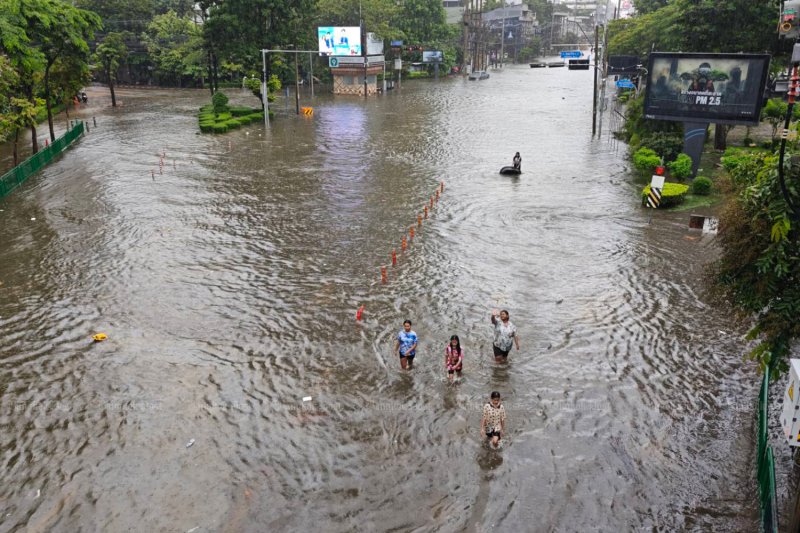
All 50 districts of Bangkok were declared disaster zones on Saturday after almost 48 hours of heavy rain that caused widespread flooding, traffic problems and disruptions to daily life.
Schools will close on Monday and government workers are being encouraged to stay home as Bangkok tries to keep traffic off flooded roads, Governor Chadchart Sittipunt said.
The disaster declaration allows the Bangkok Metropolitan Administration (BMA), other state agencies and local administrations to respond more quickly and systematically in affected areas.
It came as heavy rain continued to cause flooding and traffic problems in several parts of the capital, with eastern Bangkok among the hardest-hit areas.
Pathum Thani province also declared Rangsit municipality an emergency disaster zone as rain continued into Saturday evening.
A cell broadcast alert was sent to Bangkok residents shortly after 9am, saying water levels in canals were already at critical levels and were expected to rise further.
According to the Meteorological Department, the main cause of the unsettled weather is a strong low-pressure system covering the lower Central Plains, Bangkok and surrounding provinces. The southwest monsoon over the Andaman Sea, the South and the Gulf of Thailand is also strengthening.
Heavy rain is expected to continue until Sunday nationwide, the department said.
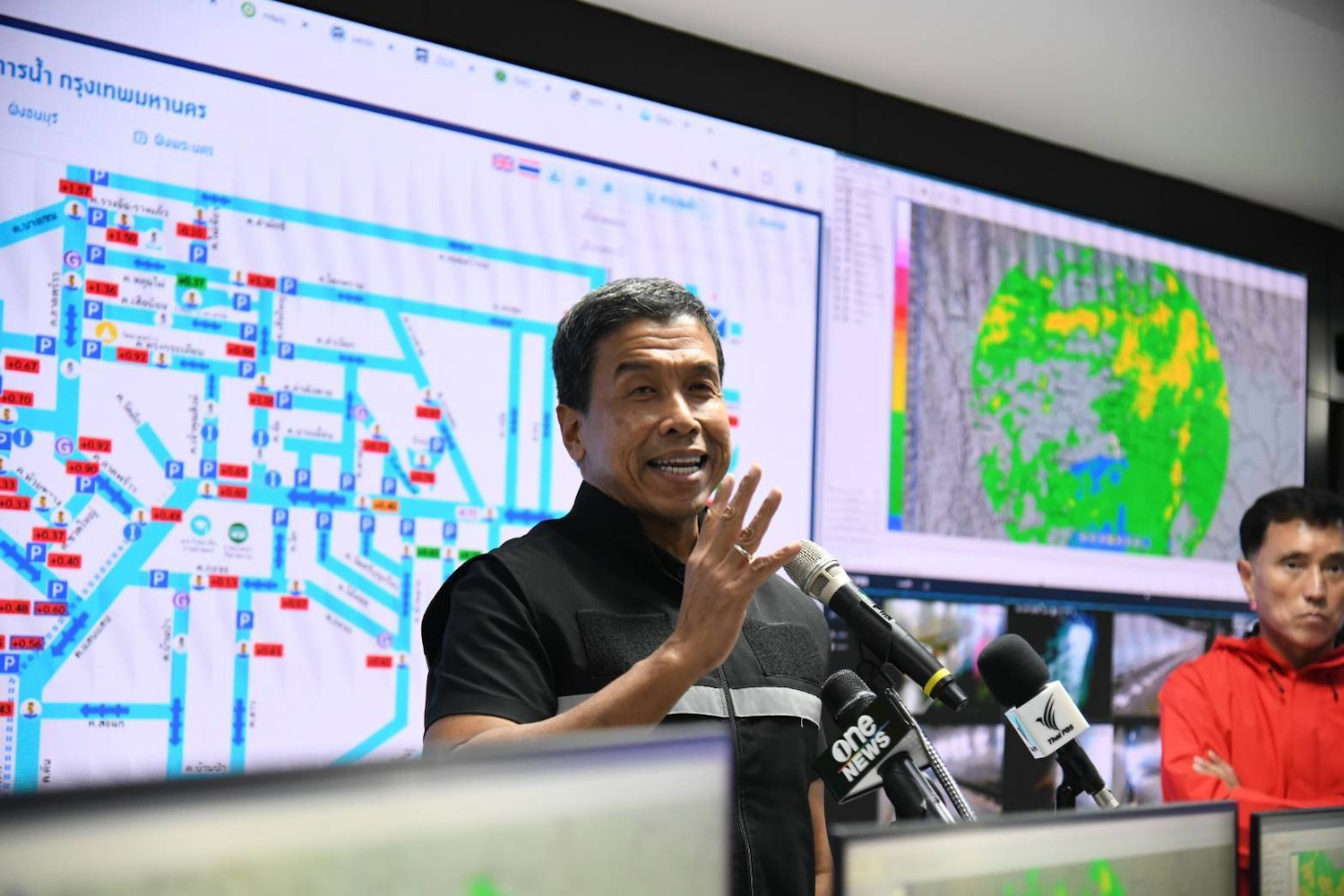
Bangkok Governor Chadchart Sittipunt delivers an update on flooding conditions on Saturday afternoon. (Photo: BMA)
Wetter than usual
September is the peak of the rainy season in Bangkok but it has been wetter than usual, according to figures from the BMA Drainage and Sewerage Department.
The capital recorded 487mm of rain between Sept 1 and 25, compared to an average of 269mm for the same period from 1991 to 2020, it said.
Water levels began to stabilise around midday Saturday thanks to the city’s pumping stations, which were operating at full capacity, pumping out 1,200 cubic metres per second combined.
“If the rain stops, it is expected that it will take 2-3 days to drain the floodwater,” Mr Chadchart said in a mid-afternoon update broadcast on social media.
The governor also assured the public there would be no repeat of the flooding catastrophe of 2011 and “no need to panic”, as some people raced to stock up on essentials in case the flooding worsens.
Witnesses reported a Makro store in Ram Inthra was packed, with the parking lot overflowing onto the street. People were stocking up on essentials, with instant noodles, drinking water and canned fish seen in every shopping cart. (Story continues below)
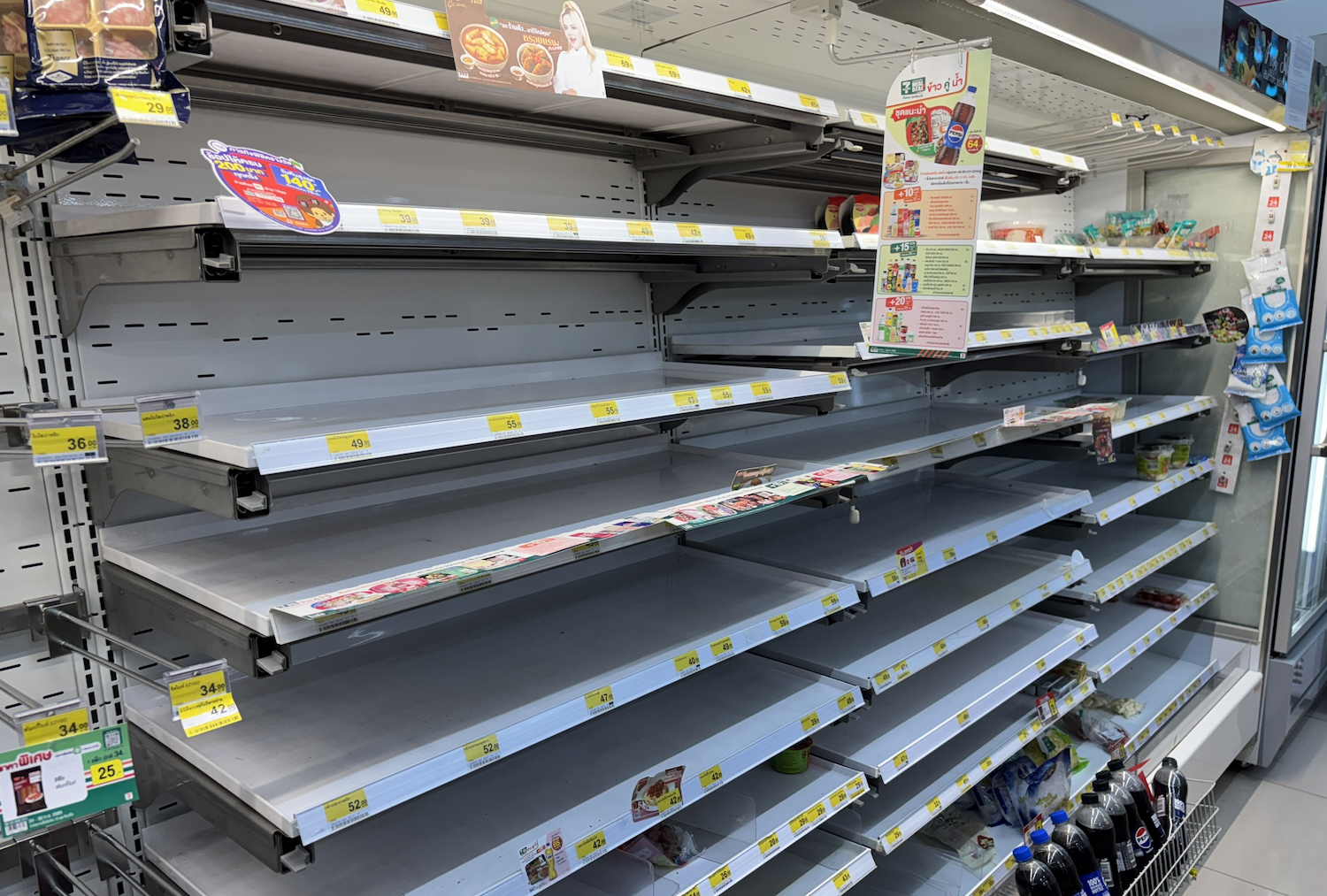
Shelves at a 7-Eleven store in the Pracha Chuen area of the capital on Saturday morning.
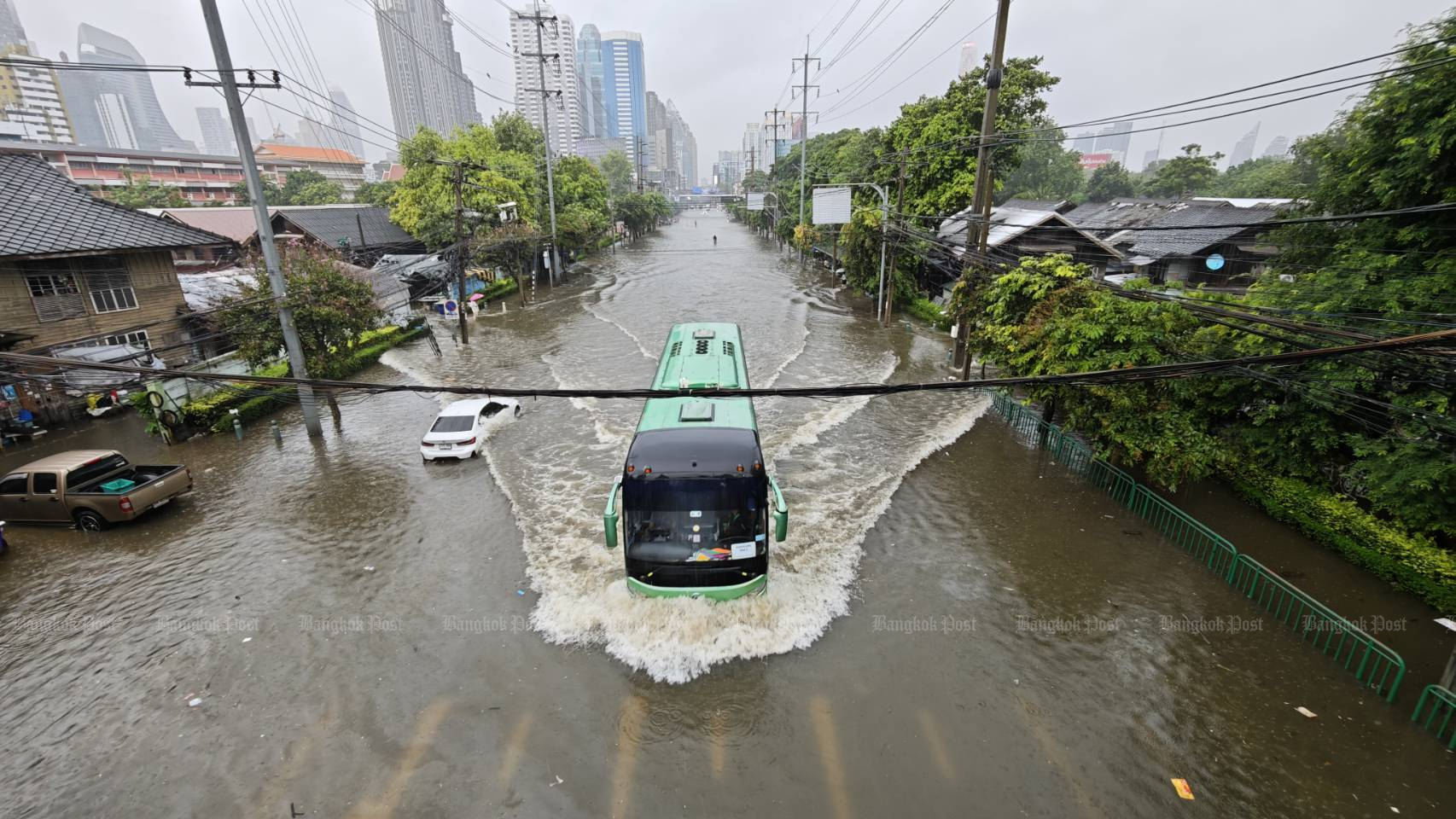
Flooding at the Mitr Samphan Intersection on Phetchaburi Road in Bangkok on Saturday. (Photo: Jetjaras Na Ranong)
Meanwhile, Prime Minister Anutin Charnvirakul was returning ahead of schedule from London, where he was leading an investment roadshow, to monitor the flood response.
Addressing officials during a teleconference before his departure, around 4pm Thailand time, he stressed that the response must integrate weather monitoring, disaster mitigation, irrigation and transport under a single, seamless management framework.
Upstream from Bangkok at the Chao Phraya Dam in Chai Nat province, water discharges were gradually being increased to 1,950 cubic metres per second, from 1,850 cu m/sec, according to the Royal Irrigation Department.
People living in low-lying areas along the Chao Phraya, downstream of the dam and along the Noi River were urged to closely monitor water levels and official announcements and prepare for possible changes in the situation.
Varying degrees of flooding were also reported in 20 other provinces: Nakhon Ratchasima, Chanthaburi, Phetchabun, Chon Buri, Chachoengsao, Buri Ram, Surin, Sing Buri, Samut Prakan, Nakhon Sawan, Phichit, Rayong, Ang Thong, Chai Nat, Uthai Thani, Prachin Buri, Ayutthaya, Sa Kaeo, Phitsanulok, Suphan Buri and Nakhon Phanom.
