
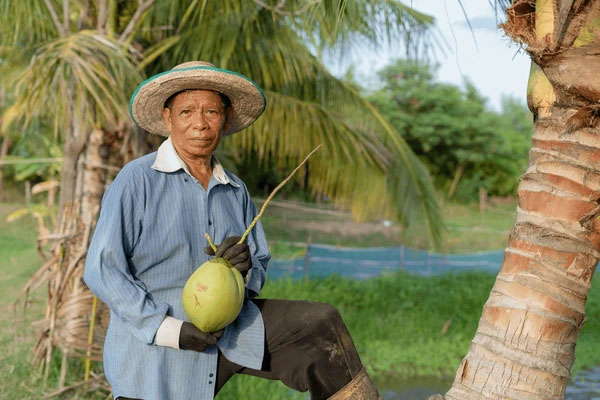
There’s a new freebie appearing at some Thai petrol stations. Instead of getting a plastic bottle of water, you get something much sweeter: a coconut.
The shift is part of a broader government effort to stabilise falling prices for Thailand’s aromatic Nam Hom coconuts, one of the country’s most recognisable agricultural products. According to recent reporting, the Ministry of Commerce has been rolling out a series of measures across the coconut supply chain after prices dropped sharply in recent months.
Among those measures: linking coconut farmers directly with petrol stations in Bangkok and nearby provinces so the fruit can be distributed to customers in place of complimentary drinking water; one piece of a wider intervention designed to absorb surplus supply.
Officials say the government has already worked through several rounds of price-support activity. Between July and September 2025, over 800,000 coconuts were absorbed from the market through purchase points and sales initiatives in producing areas such as Ratchaburi. Later in the year, another 460,000 coconuts were moved through distribution programmes, including the petrol-station channel. A third phase now aims to manage around one million coconuts by expanding purchase points in key producing provinces and increasing retail distribution in Bangkok and surrounding areas.
The logic behind using petrol stations is fairly practical. Thailand has thousands of service stations spread across highways and urban neighbourhoods, many operated by companies such as PTT Public Company Limited, Bangchak Corporation and PTG Energy. In recent years, these stations have evolved into roadside retail hubs with cafés, convenience stores and rest areas that draw steady daily traffic, making them useful distribution points for agricultural products. Instead of relying solely on traditional wholesale markets or fruit vendors, the government can push coconuts directly into a space where millions of drivers already pass through. Even small quantities at each location can add up when distributed across hundreds of stations.
The initiative is also part of a larger attempt to support the entire coconut value chain. Authorities are pushing new export markets beyond China, organising international trade events for fruit exporters, and tightening oversight of coconut imports to prevent domestic prices from being undercut. At the same time, officials are investigating coconut packing houses and intermediary businesses suspected of operating under nominee structures that may distort the market. For farmers, the goal is simple: create more outlets for their harvests.
Thailand’s coconut industry remains an important part of the country’s agricultural landscape, particularly in provinces such as Ratchaburi, Samut Sakhon and Samut Songkhram. Many growers operate on relatively small plots of land, meaning price swings can quickly affect household income. Policies that create additional demand through export promotion, retail partnerships or government purchasing, can help smooth those fluctuations. The petrol-station coconut programme doesn’t solve every structural challenge facing the sector. Agriculture is still shaped by weather patterns, global competition and shifting consumer markets, but it does illustrate how policy sometimes doesn’t solve every structural change facing the sector, but it does illustrate how policy sometimes works through everyday spaces.
So, during your next road trip, you might stop on the highway to grab a coffee or stretch your legs only to find that instead of leaving with a bottle of water, you walk away holding something grown a few provinces away: a coconut.