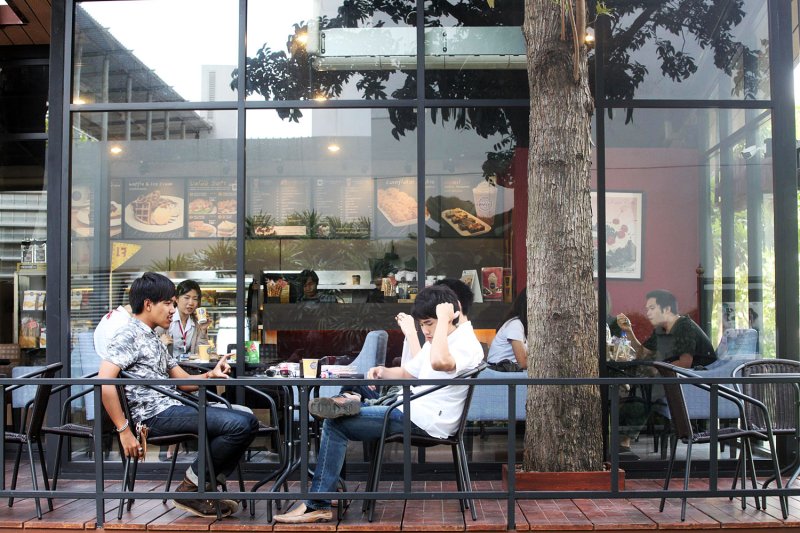
For eight days in early May, a cafe in Bangkok became a space where people showed up to think seriously about labour. They came for film screenings and panel discussions and poetry readings and an art workshop, and they stayed for the conversations that ran long after each session ended.
Rang Khon Ngan, or See The Workers Week, was organised by a youth-led collective and ran from May 1-8 at Arai Arai Cafe, and what it demonstrated, quietly and without making a large claim about itself, is that a younger generation of Bangkokians is paying attention to questions that do not always get asked in this city -- who does the work that keeps it running, under what conditions, and what do those people actually need?
Bangkok functions through the labour of people who are rarely the subject of any conversation about what makes the city worth living in. The food gets cooked and delivered, the buildings go up, the households run and the city's enormous informal economy absorbs the labour that makes all of it possible. A significant portion of that workforce sits outside standard employment protections, navigating conditions that most people who live comfortably here do not have much reason to think about, and May 1, Labour Day in Thailand, tends to pass without much disruption to that arrangement.
This year it also passed during one of the most sustained heat events the city has seen, with Bangkok's heat index sitting in the danger category for nearly four weeks. Fifty-nine thousand people used the city's cooling centres over that period, which is a different population from the delivery driver threading traffic through 39C air, still working. The heat made visible something that is usually easier to look past -- that the experience of living in this city is not uniform, and that comfort here has always been unevenly distributed.
Some of that awareness is generational in a way that feels specific to this moment. Young people in Bangkok are more connected to conversations about labour, inequality and ethics happening elsewhere in the world than any previous generation has been, not through formal education or political affiliation but through the same phones and platforms that also deliver their food and track their rides. The ethics of how things get made and who pays the price for convenience have become part of the cultural vocabulary of young people here, and it shows in the pattern of mutual aid, open advocacy and community organising that has become a recognisable feature of Bangkok's younger social landscape. Ideas about fairness and solidarity that might once have stayed local now travel fast, find resonance across borders and come back shaped by a much wider conversation.
Blood Berries, a documentary about itinerant Thais harvesting berries in Sweden and Finland screened as part of Rang Khon Ngan, drew exactly the kind of audience the programme was designed for -- people who came curious and left thinking harder than when they arrived. The workers in the film are specific people describing specific choices made under conditions that were not really choices, Thai nationals who travelled thousands of kilometres for seasonal work and found themselves dependent on a single employer with limited ability to walk away, a version of the same logic that governs a lot of labour in Thailand whether or not a border is involved. Watching it in a room full of strangers who were genuinely paying attention is its own kind of thing.
That quality of attention was what Rang Khon Ngan was really about. The week opened on May 1 with a panel on women's labour and a screening of a documentary about factory workers' struggles, and closed eight days later with a performance combining art, ritual and storytelling, which is an unusual shape for a Labour Day programme and a deliberate one. In between, there were panels with labour organisers including a representative from Bangkok's motorbike taxi union, a live reading of poems and written works submitted by workers themselves, and an art workshop built around the idea that rest and emotional recovery are also labour issues. It provided a casual enough space that people could engage openly, not just with the content itself but with the like-minded strangers around them, and whether someone came for the labour politics or simply for a film screening on a Saturday afternoon, they left having participated in something more than what they came for.
The collective behind it is not affiliated with any institution or political party, which means the week existed entirely because a group of young people decided it should, sourced the speakers, built the programme, and opened the doors. That kind of organising is harder than it looks and less visible than it should be, and it is happening more than people realise. The people asking questions at the end of each session were not labour academics or NGO workers but young Bangkokians who showed up and stayed, and that is where things tend to start.
Chavisa Boonpiti is a contributor at Bitesize Bangkok, a digital news outlet.