 Listen


 Facebook
 Reddit
 Copy Link


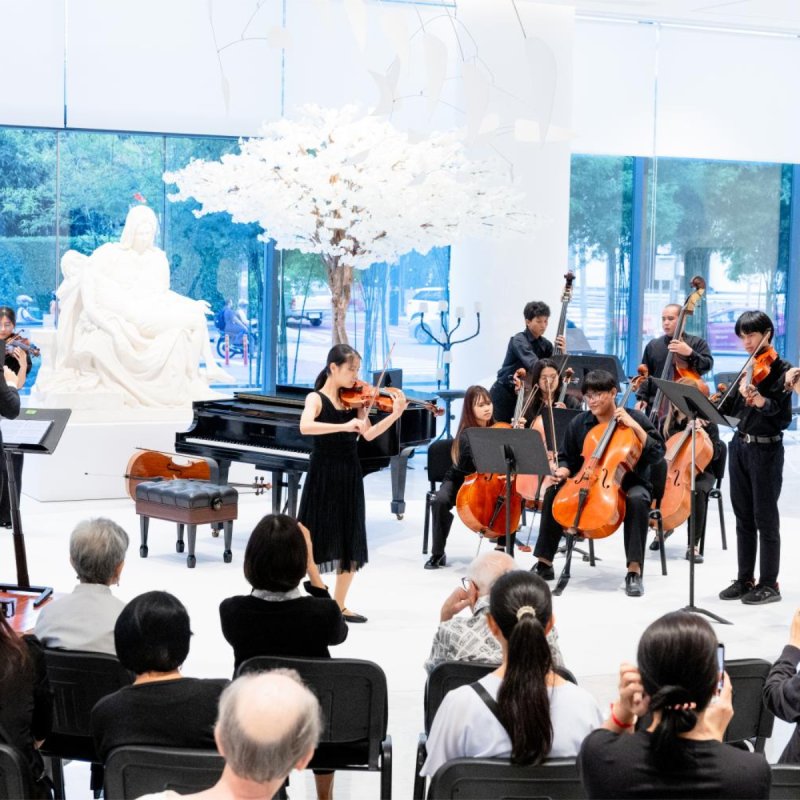
Inspirational music-making of the most heartwarmingly collaborative variety was on full display recently at the latest Sounds Of Wireless series performance, presented by the combined talents of the Royal Bangkok Symphony School (RBSS) and the truly exceptional Immanuel Orchestra, a charitable music education project which provides free string instrument tuition for under-privileged boys and girls from one of Bangkok's poorest districts, Klong Toey.
The venue was the impressively expansive open-plan ground floor of the spaciously conceived, modernistic Kian Gwan Building at 140 Wireless Road.
Sounds Of Wireless is a fresh and exciting initiative from the RBSS -- organised by the school's visionary, newly-appointed director Dr Tretip Kamolsiri, which presents professional chamber music-sized events regularly on Saturday afternoons at this opulent, inviting downtown location, literally just across the road from Lumpini Park on its northern side.
However, this particular concert had a somewhat different, quite inspired design to it by successfully bringing together young musicians from totally contrasting socio-economic backgrounds and melding them together as a cohesive, genial performing whole.
Immanuel Orchestra, which was created by Norwegian Lutheran missionaries Solveig Johannessen and Reverend Dag Johannessen in 2000, opened this concert with Pachelbel's famous Canon In D Major, making clever choreographic use of the impressive spiral staircase which leads up to the next floor, as if from a Cecil B. DeMille film set.
Sat in the middle of the carpeted stage area, cellist Apiwat Khanthahut introduced the repeating ground-bass, whereas the initially invisible ranks of violins and violas emerged gradually as they played, tiptoeing and spiralling their way down the staircase very carefully one-by-one, before taking their conventional desk positions in the respective sections.
It was a most ingenious way of introducing this ensemble of some two-dozen teenaged boys and girls, whilst their brilliant artistic director and conductor Dr Krit Niramittham joined for the closing variations on the concert grand pianoforte.
The great concertos of Antonio Vivaldi featured prominently in this programme, and the next item was Concerto For Four Violins In B Minor RV 580.
Of course, three centuries ago the so-called "Red-Haired Priest" himself had been music director for a similarly charitable orphanage for girls in Venice, Italy, at the stunning Ospedale della Pietà church.
Inevitably, many parallels came to mind whilst enjoying Immanuel Orchestra's highly accomplished playing in contemporary Bangkok, which itself has historically been referred to by travellers as the Venice of the East, due to both city's canal systems.
RBSS students Sari Manomaiphibul (taught by Daniel James Hudson) and Phumraphee Traitanon (taught by Pisoot Saay Op Oua) played the 3rd and 4th solo violin parts with composure, focus and fine intonation for the whole of this exhilarating work, whilst the three movements of the 1st and 2nd solo parts were performed with equal distinction by a number of rotating Immanuel players -- Chaiyanan Wongsa; Porpiang Buddeekong; Thitiwut Thongtawat; and Pannathat Shingchin.
The concertmaster was Yatavee Ouengbanchong and cello continuo was played by Praewnapa Phatngoen. Even some tutti section members were allotted short solo spots, immediately revealing myriad admirable qualities of this remarkable training orchestra and its exceptional, possibly unique organisational "culture".
All members are clearly made to feel equally important as valued team players; they are given ample opportunities and space to develop at their own natural pace; and dedicated tutors encourage with positive energy at all times in a holistically enriching environment, devoid of any negative peer-pressure or unnatural, pressurised expectations.
Heading the educational team alongside conductor Dr Krit is professional cellist and Foundation director Siripong Keetasilsakul, and the warming, sharing approach duly continued into the next item, Vivaldi's Concerto For 2 Cellos In G Minor RV 531.
The truly virtuosic 1st movement Allegro solo parts were once again expertly handled by two RBSS students, Alana Meylan and Natapat Traitanon (taught by Pannada Poompanich and Amy Bunayamongkol), followed in kind by Immanuel Orchestra's Apiwat Khanthahut, Kittisak Sirorattanakasem, and Praewnapa Phatngoen for the solo parts of the Largo and Allegro.
Meanwhile, concertmaster duties here were given to Chaiyanan Wongsa, with Saowapha Jamkoksoong on cello continuo.
A change of stylistic gear for Joseph Haydn's gorgeous Piano Concerto In D Major Hob. XVIII:II followed next, featuring three highly accomplished young piano students of RBSS concert pianist Dr Jayanat Wisaijorn.
Akka Asvanund delivered the Vivace first movement with admirable control and poise; Harry Fiocchi interpreted the central Adagio with a cool head and fine, delicate touch; and Warakorn Monkatha dispatched the finale Allegro assai with note-perfect precision. As this wondrous opus unfolded there was undeniably the increasing sense that an orchestra at ease with itself (and of course their conductor) is always likely to sound much better, and certainly more unified in its musical mission.
The fact is that much of this concerto performance was convincing enough to have been of a professional level, which in this exacting, transparent classical style in particular really is stating something quite profound. String players rendering this mature Haydn work so cleanly, and with such subtle phrasing, is arguably on a par with the ultimate challenge of Mozart.
It was back to Vivaldi for the next item, the iconic Violin Concerto In G Minor RV 315 (Summer from The Four Seasons) and yet again the collaborative democratisation of roles was manifest by the allocation of different soloists for each movement.
Allegro non molto and Adagio e piano and Presto e forte were played respectively and confidently by Immanuel Orchestra's Kittikun Saiyotha and Tidatan Vongvormaikul (who then relocated humbly to the back of the 2nd violins for the finale!); whilst young Japanese sensation Hiromi Mukawa, an RBSS student of Kru Kanin Dan Udommana, quite deservedly received the loudest "Bravo!" of the whole concert.
Meanwhile, Pannathat Shingchin was concertmaster for this work, and Apiwat Khanthahut was cello continuo.
The main body of the programme was completed by Edvard Grieg's evergreen Holberg Suite Op.40, selected in large part because of the Norwegian connection to Immanuel Orchestra's missionary founders. Krit Niramittham conducted all movements.
A charming encore was offered in the form of Leroy Anderson's cheeky pizzicato joke-piece Plink, Plank, Plunk!. The orchestra now in perfect rhythmic synchronicity, it brought a huge smile to everyone's face, before a second encore of a rather more earnest nature re-focused the mood.
J.S. Bach/Gounod's Ave Maria, performed on solo cello by Siripong Keetasilsakul (Kru Jiew), reminded one of the essentially spiritual/devotional nature of the Immanuel Orchestra project from its outset -- "God with us" -- leading to genuinely worthwhile music-making and personal development.
Indeed, placed right behind the stage area and performers was a large white statue of the Mother Mary with the suffering son Jesus in her arms.


