


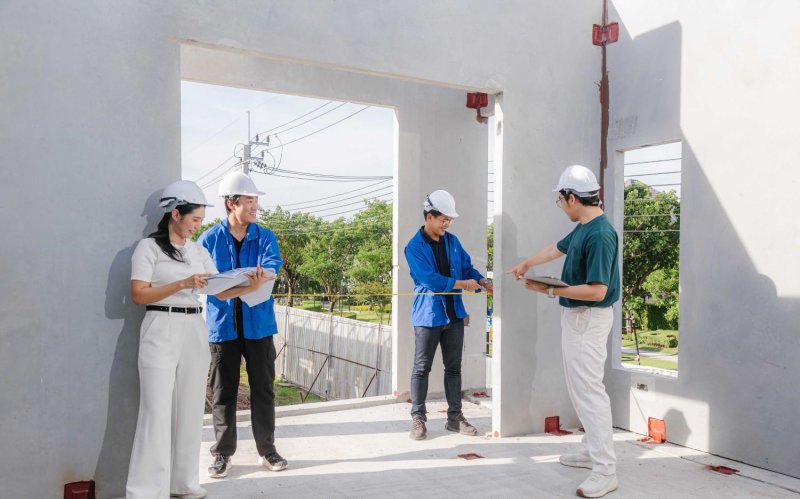
Although the self-built home market is sizeable, with an annual value of up to 200 billion baht, residential developers had largely overlooked the segment until last year when a handful of large and mid-sized developers entered the fray.
These companies have since launched dedicated business units and tailored construction services to capture demand from landowners seeking to build homes on their own plots rather than purchase units in housing estates.
WHY HAVE RESIDENTIAL DEVELOPERS IGNORED SELF-BUILT HOMES?
Residential developers in Thailand traditionally follow a clear business model, selling houses together with land within their own projects. They do not typically build homes on customers' land for several reasons.
Profit margins from project development are significantly higher than from homebuilding, as land is a key source of profit.
Project development also benefits from economies of scale, as large volumes lower construction costs. The use of prefabrication systems further improves speed and cost efficiency.
Many developers also offer ready-built homes, allowing them to fix profit margins and selling prices in advance, as costs are already known.
On average, low-rise residential development generates net profit margins of at least 12-15%, while margins from homebuilding services are typically lower.
WHAT MAKES THE SELF-BUILT HOME MARKET ATTRACTIVE?
The self-built home market in Thailand has shown steady growth, typically expanding at a single-digit rate annually.
While growth is modest, it remains healthy and does not contract as sharply as the residential development market during economic slowdowns because those who build homes on their own land usually already own the plot.
Once funding is available, they can begin construction. Even if financing is required, securing loans is generally easier as the land can be used as collateral.
According to the Real Estate Information Center, nationwide home construction loans extended by the Government Housing Bank grew every year between 2018 and 2022.
The number of loan accounts rose from 168,549 worth 113 billion baht in 2018 to 183,879 accounts worth 156 billion in 2022, an annual growth of 1.4-2.7% in volume and 8.2-9.5% in value.
Manu Trakulwattanakit, managing director of Seacon Co, Thailand's largest homebuilder, said the nationwide self-built home market contracted by around 10% to 190 billion baht in 2025 from 211 billion in 2024.
Broken down by area, Greater Bangkok recorded a sharper decline of nearly 15%, from 51.4 billion baht to 43.7 billion, while upcountry markets fell 8% from 160 billion baht to 146 billion.
By comparison, the residential development market tallied a steeper 16% decline in presales last year, dropping from 518 billion baht to 436 billion, according to Pruksa Real Estate, a residential development subsidiary of SET-listed Pruksa Holding.
Greater Bangkok presales fell 17% to 267 billion baht, while upcountry markets declined 14% to 170 billion baht.
WHAT PROMPTED DEVELOPERS TO ENTER THE SELF-BUILT HOME MARKET?
Major developers such as Sansiri and Pruksa are turning to the self-built home segment, considered a blue ocean market as they attempt to offset prolonged stagnation in traditional housing estates and condos.
The broader residential market is facing a perfect storm of high household debt and mortgage rejection rates of up to 50% in some segments.
In contrast, demand in the self-built home market remains resilient, with far fewer loan rejections.
The enforcement of the land and building tax over the past few years has also prompted many landowners to either develop or sell idle plots. Some buyers prefer purchasing these plots to build homes in locations of their choice.
"Many people want well-designed houses but do not want to buy in housing estates, either because they already own land or prefer not to pay annual common area fees, which can run into tens of thousands of baht," said Mr Manu.
Valued at roughly 200 billion baht annually, the self-built home market is highly fragmented and dominated by small contractors, which account for about three-quarters of market share.
The remaining quarter is largely served by companies that are members of the Home Builder Association.
Developers entering this market compete directly with established homebuilders, where trust is the primary currency.
Customers who choose homebuilders are often willing to pay more than hiring individual contractors in exchange for brand credibility and reduced risk of project abandonment.
While some homebuilders have faced financial strain during economic downturns due to aggressive pricing and cost overruns, large developers bring stronger balance sheets, established brands and standardised construction systems, giving customers greater confidence.
Their existing projects nationwide also serve as de facto showrooms, allowing prospective buyers to review designs and construction quality.
Developers with provincial projects have an added advantage, as upcountry customers typically have fewer homebuilder options.
Compared with selling homes in housing estates, where demand is shrinking and transfers are often blocked by mortgage rejections, demand in the self-built segment is considered more genuine and less constrained by financing issues.
The market response has been positive. Pruksa recorded 480 million baht in sales for the segment last year, while SET-listed Sansiri secured sales worth 280 million baht in eight months after entering the market in April 2025, and registered 100 million baht in sales the first two months of this year. Sansiri is aiming for 650 million baht in sales this year.
Entering the self-built home market also enables better resource utilisation amid a residential slowdown, as developers can tap into significant idle capacity, including architects, engineers, supply chains and precast concrete factories.
Instead of letting these resources sit idle while waiting for the next major project, developers can utilise them for individual homebuilding, keeping factories running and skilled labour employed, turning fixed costs into revenue-generating assets.
HOW WILL HOMEBUILDERS ADAPT?
Although the self-built home market has no barriers to entry for developers, the business is not easy for them, said Mr Manu.
"In the homebuilding business, foremen meet and communicate directly with customers, as homeowners frequently visit sites to monitor progress and request design adjustments during construction," he said.
"Foremen working at property developers are not used to dealing directly with homebuyers, which increases the risk of staff turnover."
In addition, developers that offer homebuilding services typically do not allow design changes during construction, while traditional homebuilders tend to offer greater flexibility, said Mr Manu.
Most segments targeted by developers have a minimum price of around 5 million baht, leaving room for homebuilders to focus on lower price ranges, such as houses priced 2-5 million baht.
He said homebuilders may need to provide more options to customers, such as offering house designs that match buyers' budgets but can be expanded or extended in the future when they have more funds.
"When the economy improves, developers will likely shift their focus back to residential development," said Mr Manu, allowing homebuilders to retain their core customer base in the self-built home market.
Sutee Ketsiri, managing director of homebuilder Built To Build Group, said the entry of major residential developers into the homebuilding market is not a threat, but rather helps elevate the sector.
"When large companies enter the homebuilding market, which is smaller in scale than residential development, it makes the sector more attractive, creating greater momentum for both the market and customers," he said.
Homebuilding prices may edge higher as established brands enter the market, prompting consumers to compare prices and options before eventually opting for lower prices, said Mr Sutee.


