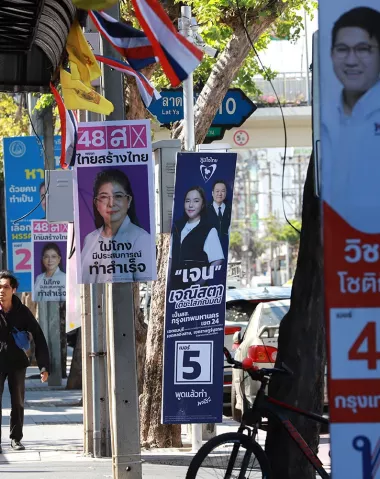
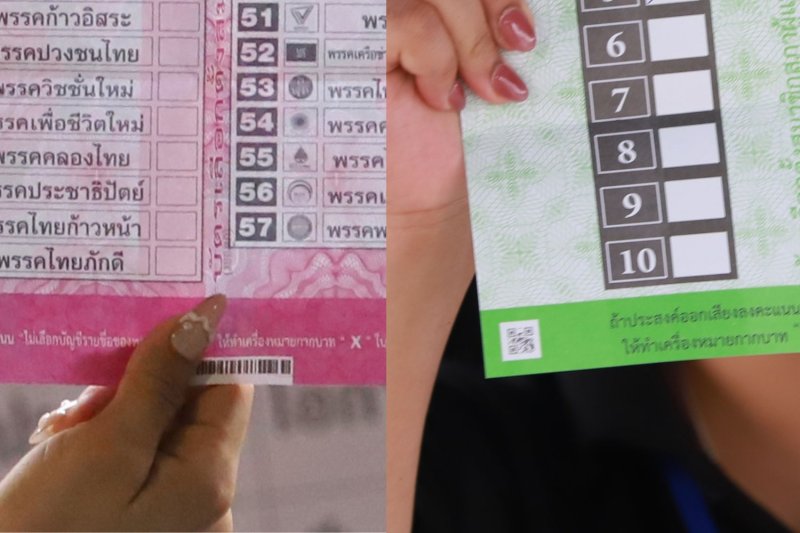
A heated debate has erupted online over barcodes and QR codes printed on election ballots, with voters questioning whether the codes could be used to trace who voted for whom, potentially violating constitutional guarantees of ballot secrecy.
A social media user specialised in IT analysed the barcode system and found that each ballot contains a unique code. Using mathematical calculations, they determined it's possible to identify which booklet a ballot came from and its sequential number within that booklet.
Since polling station officials record the sequence in which ballots are issued, and ballot stubs contain corresponding numbers, the ballots could theoretically be matched to individual voters, fundamentally contradicting the principle of secret voting.
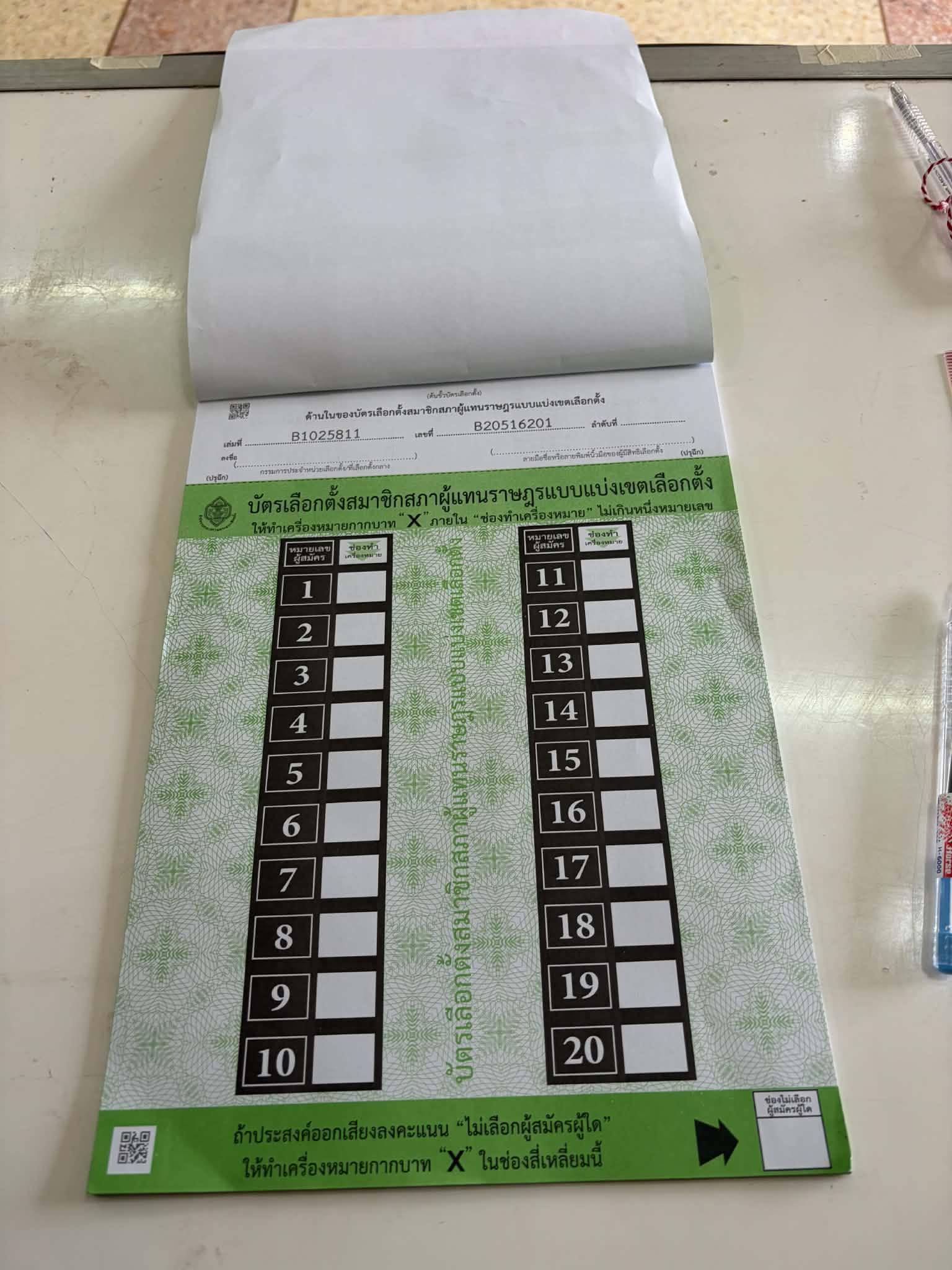
The ballot attached to the stub, which contains the booklet number. (Photo: Thanarat Kuawattanaphan)
EC response
Deputy Secretary-General of the Election Commission Phasakorn Siripakdayaporn defended the barcodes as batch numbers for tracking production lots and distribution, insisting they were security measures to prevent counterfeiting rather than voter tracking. He emphasised that the information was kept confidential by the EC.
Notably, yellow ballots for the constitutional referendum contained no barcodes or QR codes.
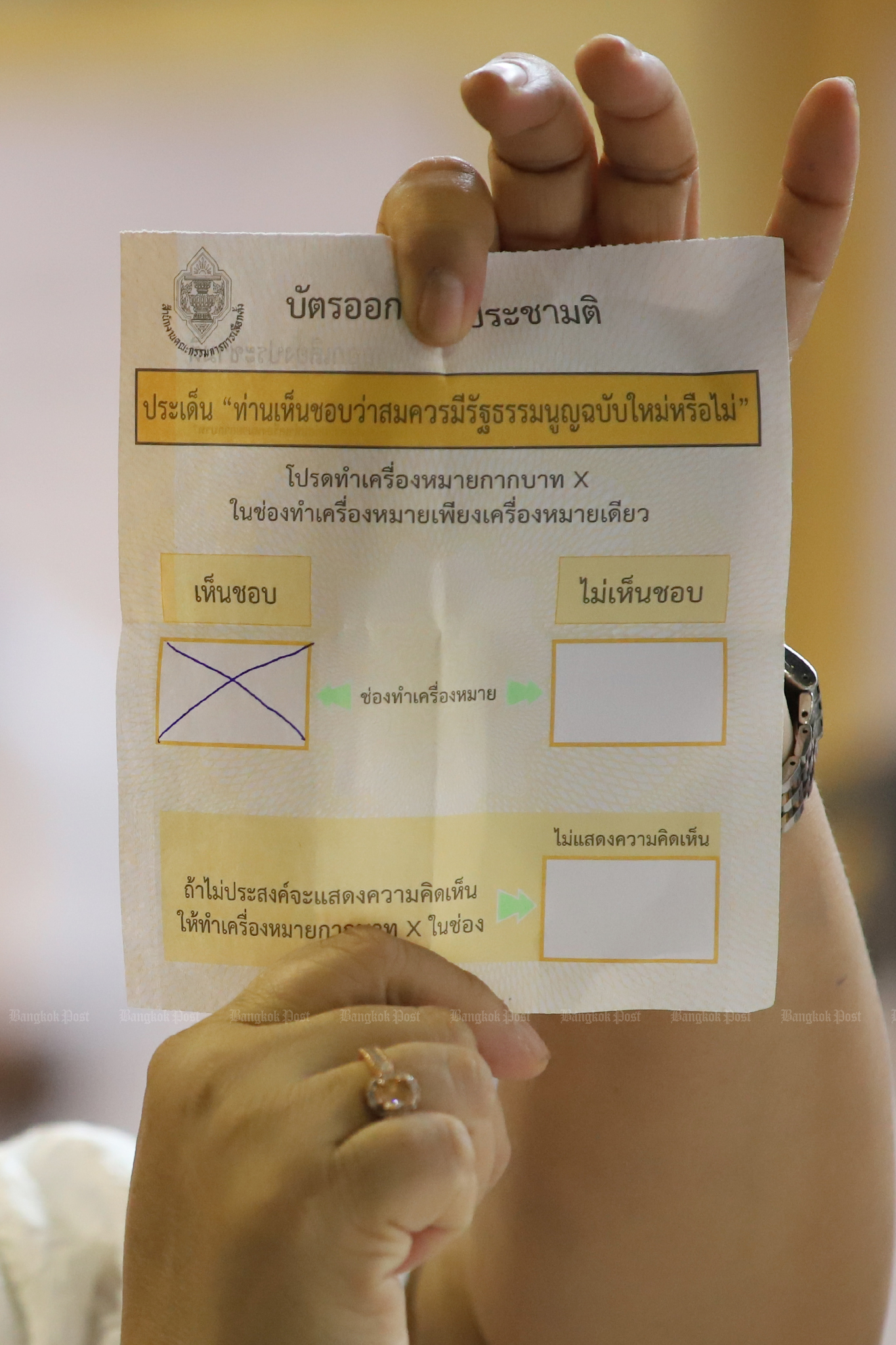
The yellow ballots for the constitutional referendum contained no barcodes or QR codes.
Expert analysis
Former EC member Somchai Srisutthiyakorn noted the ballots' high cost — 1.40 baht for pink, 1.20 baht for green and 1.00 baht for yellow — with approximately 56 million of each printed by three printing houses.
The ballot specifications include watermarks visible only under ultraviolet light and micro-text requiring magnification — security features against counterfeiting authorised under Election Regulation 129, which permits the EC to add codes or marks without prior notice.
However, if barcodes reveal which booklet a ballot came from, and that booklet can be matched to voters through registration records, voter identification becomes possible — violating Article 85 of the Constitution, which mandates direct and secret voting.
Constitutional precedent
Former member of the Thai Sang Thai Party, Lt Sita Tiwari, warned that if barcodes link ballot numbers to stubs bearing voters' signatures, this could breach constitutional requirements.
He cited the Constitutional Court's 2006 ruling that nullified the April 2 election because some polling booths failed to guarantee ballot secrecy. The court's standard wasn't whether anyone actually discovered how someone voted, but whether the system structurally permitted such breaches.
The fundamental principle, Lt Sita stressed, is that election systems must not create any possibility of tracing votes back to individual voters.