
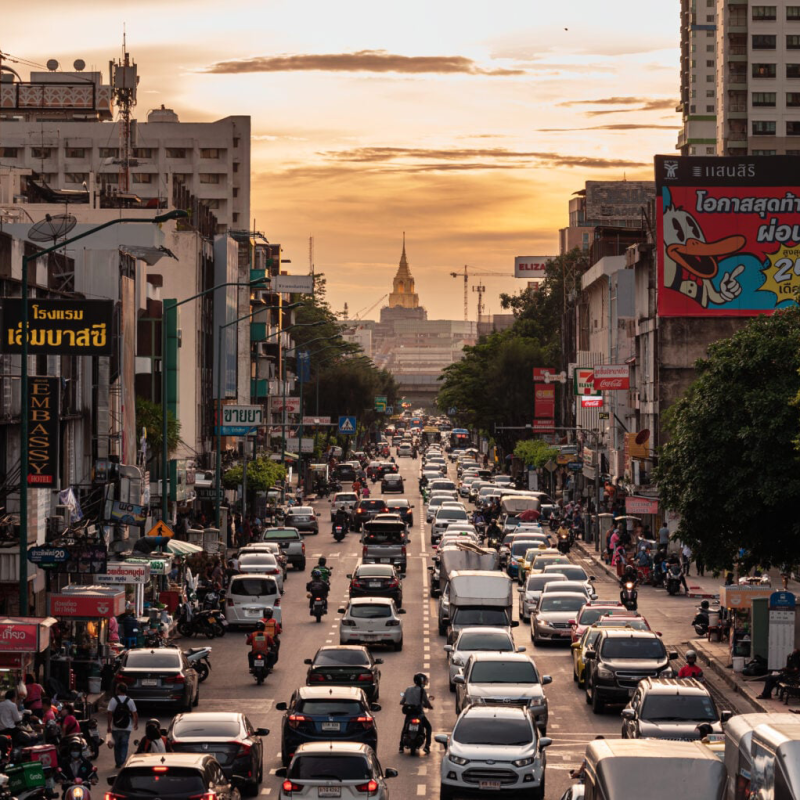
Morning work commutes in Bangkok are tackled like olympian tasks. For some, it's a trudge down a narrow soi, followed by a motorbike taxi serpentining through traffic, leading to a transfer onto the BTS or MRT. Especially ambitious commutes may end with a walk across a skywalk or through a shopping complex before reaching the office. What looks like a straightforward commute on a map instead looks like a series of compromises one makes with the city.
For millions of residents, this complex choreography is their daily routine. Bangkok's congestion has long ranked among the most intense in the world, with many commuters spending close to two hours a day in traffic or moving between different transport modes to reach work. Thus, mobility becomes integral to everyday life. Time spent commuting affects productivity, social life and even your spending, as more transfers means more costs. It also reveals something deeper about how cities function. Traffic congestion is rarely just a transport problem; it's usually a planning problem and Bangkok's urban structure helps to explain why.
Much of the city's growth over the past several decades was organised around roads rather than public transport. As the population expanded and incomes rose, car ownership followed. Housing developments spread outward from the historic core, while offices and commercial districts cluster in specific areas. As the distances between these zones grew longer, so did the number of vehicles on the road. When the city is built primarily for cars, commuting becomes unavoidable. When a city is built for people, mobility begins to look smoother.
This is where the idea of walkability enters the conversation. Urban planners increasingly describe walkable cities as places where everyday needs (work, groceries, schools, public spaces) are reachable on foot or through short transit connections. The benefits go well beyond convenience. Research consistently links walkable neighbourhoods with improved public health, stronger local economies and lower environmental impact. Walking is also the most accessible form of transportation available to cities. It requires no fuel, produces no emissions, and supports the broader efficiency of public transport networks by helping people move between stations and destinations.
In practice, walkability is not just about sidewalks. It depends on how a city arranges its spaces. Streets need safe crossings, shade and continuity. Transport needs to be accessible and reliable. When those elements align, streets become more active, local businesses benefit from increased foot traffic and residents spend less time travelling long distances across the city. Walkable environments also encourage everyday physical activity, which can reduce chronic disease and improve mental health outcomes.
Bangkok has not historically been known for walkability. Sidewalks can disappear mid-block, crossings can feel hazardous and the last kilometre between transit stations and final destinations often involves improvisation. Informal solutions such as motorbike taxis or ride-hailing services have filled those gaps for years. In recent years, there has been a hopeful and gradual shift in the right direction.
Bangkok is now in the middle of a large-scale transformation of its transit infrastructure. Under the Bangkok Mass Transit Master Plan, the rail network is expected to expand dramatically in the coming decades, eventually reaching roughly 495 kilometres of interconnected lines. New routes such as the Pink, Yellow, Orange, and Red lines are already extending the reach of the system across the metropolitan region.
Rail expansion alone does not solve congestion, but it's a positive step in the right direction. Stations become focal points for development, encouraging housing, offices and commercial activity to cluster around transit hubs rather than highways. This model, often referred to as transit-oriented development, gradually shortens travel distances while reducing reliance on private cars. On the road, Bangkok's public bus fleet is beginning a transition towards electric vehicles, with plans to replace more than 2,300 conventional buses over the coming decade. Cleaner buses reduce air pollution, but they also form part of a larger shift towards a more integrated mobility network.
Urban planning itself is evolving as well. Large mixed-use projects such as One Bangkok reflect a broader interest in the "15-minute city" concept, where residents can reach daily necessities within a short walk, cycle, or transit ride. Instead of separating work, housing, and recreation across distant districts, these developments aim to compress daily life into more walkable neighbourhoods.
The underlying goal of many current projects is not simply to move people faster across the city but to reduce how far people need to move in the first place. Walkable streets, connected transit lines, and mixed-use neighbourhoods all point towards the same idea: a city where daily life happens closer together. In a place long defined by its gridlock, that shift could eventually reshape the Bangkok commute itself.
Chavisa Boonpiti is a contributor at Bitesize Bangkok, a digital news outlet.