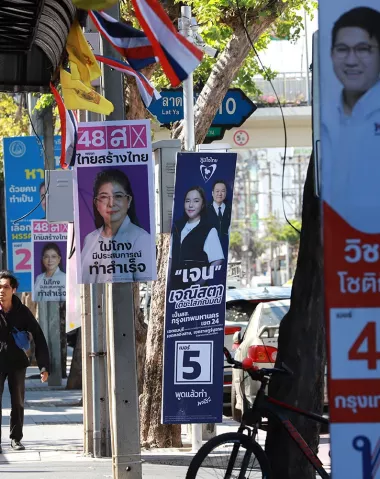
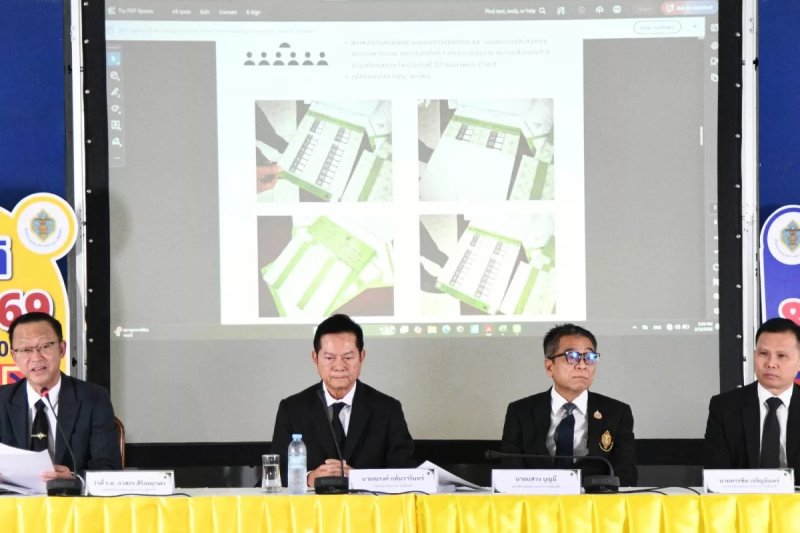
The People’s Party on Thursday filed a criminal complaint against the Election Commission (EC), alleging misconduct in its handling of the Feb 8 general election, including the use of “identifying marks” on ballot papers and dereliction of duty.
Dr Wayo Assawarungruang, a deputy leader, accompanied by the party’s legal team, submitted the complaint at the Criminal Court for Corruption and Misconduct Cases.
The complaint accuses nine people of dereliction of duty under Section 157 of the Criminal Code and Section 69 of the Organic Act on the Election Commission. It also alleges breaches of Section 164 of the Organic Act on the Election of MPs, stemming from the placement of “identifiable markings” on ballots.
The nine defendants are the seven election commissioners, along with the commission’s secretary‑general and the director of election support.
The development comes as the court prepares to rule on a separate petition involving the poll body’s leadership. It said it would decide on March 17 whether to accept a lawyer’s complaint against chairman Narong Klanwarin and seven other senior officials over the printing and use of ballot papers containing QR codes and barcodes — an issue that has fuelled public concerns about voting secrecy and the integrity of the Feb 8 poll.
Four plaintiffs named in Thursday’s case are the People’s Party as a juristic person, together with three party figures filing in their capacities as candidates and voters — party leader Natthaphong Ruengpanyawut, Dr Wayo and spokesman Parit Wacharasindhu.
Dr Wayo said the party would ask the court to summon additional witnesses, including executives of the three companies that printed constituency, party-list and referendum ballot papers.
T.K.S. Technologies Pcl printed green constituency ballots; Chanwanich Security Printing Co Ltd printed the pink party‑list ballots; and the Territorial Defence Volunteers Printing House of the Department of Provincial Administration printed the yellow referendum ballots.
The plaintiffs will also seek to submit further documentary evidence, including procurement contracts for the nationwide vote on Feb 8 and repeat votes held on Feb 22 at three polling units and a recount at one, the terms of reference for all ballot orders and minutes of EC meetings.
In addition, they will petition the court to bar the Office of the Attorney‑General from representing or assisting the defendants in the criminal proceedings.
Dr Wayo acknowledged that Section 157 requires proof of specific intent and said the party is simultaneously relying on Section 69 of the EC organic law to press its case.
He described the “identifying marks on ballots” issue as novel and cautioned that the legal proceedings could be lengthy, potentially taking up to a decade if it proceeds through appeals to the Courts of Appeal and Supreme Court.
He also clarified that the party’s recent petition to the Ombudsman was meant to channel facts to the Constitutional Court, which can rule on the validity of elections but has no criminal jurisdiction.
If the Constitutional Court finds fundamental violations of vote secrecy, it could declare the Feb 8 poll results invalid and order a new nationwide vote — potentially costing another 7 billion baht in taxpayers’ money.
As for the complaint with the Administrative Court, the court would review administrative orders, such as recounts or fresh polls.
“All eligible voters are aggrieved parties in this matter and have the right to bring a criminal case against the EC,” Dr Wayo insisted.
However, he acknowledged that corruption‑related criminal complaints against state officials involve more complex procedures and witness requirements than ordinary criminal cases.
The Election Commission on Wednesday certified the results in 396 out of 400 constituencies and is expected to certify the election of 100 party-list candidates next week.
A new parliament must convene within 15 days of the certification of at least 475 seats, 95% of the total, after which the House will elect a prime minister to form a government.
- Editorial: Election Commission crisis widens